Wednesday, August 27, 2014

Sundarbans - a Scout camp

Disclaimer: This post is not about Kolkata.

When you’re small you don’t often realise how you get into things. You are told. You are told, for instance, that you have a fever and must stay at home, you are told that you are a bad boy or a good boy, or that you are going on a camp. As it happened, one day I was told that I was going to the Sundarbans on a camping trip with a Scout troop. I was a Cub-Scout with the South Point pack, but this was with a different group who had their centre somewhere in Hati Bagan. I remember the location only because the name had excited me tremendously - just as it had disappointed by making me realise at an early age the arbitrary nature of the signifier-signified relationship.

I had been to the Sundarbans a year before that. It had been a satisfactory trip on the whole, quite luxurious to be honest. I had quickly made friends with the crew and would spend many a worrisome hour (for my parents) lurking around the kitchen, sometimes serving as food-taster. This was on a West Bengal Tourism launch. With my South Point Junior School upmarket air I greeted the prospect of the Scout camp with enthusiasm.

We were to take a bus to Taki from where a launch would take us into the delta. My expectations began to take a hit when we reached Taki. The food arrangements were modest (where were the chicken sandwiches that we were feasting on en route the first time round?), the toilets were not up to the mark, and mosquitoes attacked us as we tried to sleep. I went to sleep believing that the next day would bring us better fortune. When we reached the “jetty” I saw a boat coming towards us. One of the other Scout boys with whom I had made friends looked positively excited.

“Wait till you see the real launch”, I proclaimed to the novice.
“This is the real launch”, he replied.
I smiled patiently and said, “No, this is the boat that takes us to the launch that we will be staying on.”
“No. We’ll be staying on this one.”

I gave up on the simpleton and boarded the boat with great self-assurance. We sailed, and we sailed. The “real launch” never came. I don’t know when this idea actually sunk in. I imagine I must have maintained a safe distance from the boy. We weren’t, however, spending our nights in the boat and this came as a consolation.

We were sorted into groups and a spirit of friendly competition set in gradually. ‘Friendly’ is such a polite word, but one must play along. The group with the greatest number of points by the end of the camp would win. Win honour and prestige, that is. In the boat (the deck was made of bamboo strips) we played various kinds of games - as Scouts are wont to do. Apart from the common Scout games, there was antakshari which was popular in the school buses most of us travelled by. Sroyon and I had been placed in separate groups. Sanjoy da, who was Scout-master was one of the kindest yet most mischievous of men. And even though he realised that this separation was causing me anxiety, he did not yield.

The group-leader for Sroyon’s group was a rather sharp young man, whom we called Debasis da. On one occasion while playing antakshari (maintaining the strict orders of our groups), I thought I had Sroyon’s team cornered. Someone had already sung “Thoda hai thode ki zaroorat hai” and through some devilish ploy I had managed to end the song we were singing on “থ”. A prior knowledge of Sroyon’s stock of songs led me to assure my team-mates that we had got them just where we wanted. The counting began: থ এক, থ দুই… when we reached eight, I began to smell the fish. The smug smile on Sroyon’s face hadn’t yet been wiped off. থ নয়! And out of the blue, they started singing a song I had never heard in my life before. Clearly Sroyon had planned in advance with Debasis da who had taught him this song. The song was “থাকিলে ডোবাখানা” (“thhakile dobakhana”). The battle-lines had been drawn.

 Where we slept in Hemnagar

মা বড়তলা (Ma Baratala) - I think that’s me trying to get off the boat

One of the campfires

Sanjoy da with me and Sroyon

Bathing on the deck was something our South Calcutta schooling hadn’t entirely prepared us for (and I think I was a bit of a snob any way). But I am glad that we reluctantly but surely began to follow Sanjoy da’s lead. When we were not playing games we were keeping our eyes peeled for the possibility of a tiger-sighting. All we saw, as most tourists do, were a few crocodiles. Even from the watch-tower, the best we managed to spot were deer, although one guide did point out a few pug-marks. It made me happier to believe that there may be truth in his claim. There were some three or four cameras on board and they would be at the ready through out. Binoculars too, just in case. Each day would conclude with us heading back to base, which was a hostel of sorts run primarily on solar-power. This was in Hemnagar (a name I had forgotten but my mother somehow managed to casually recall while going through the photographs). And each night we’d have a camp-fire to the accompaniment of muri and some telebhaja.

Each group was called upon to perform. A large part of the day on the boat would be spent on attempts to come up with scripts. In the evenings, Debasis da’s group would usually make it all look futile. He could play his audience like Freddie Mercury. He’d do this thing where he’d say a line - quite random, really - something like “ডালে ঝোলে অম্বলে, ভাত না খেলে কেমন লাগে?” And the audience (that is us) would go nuts and say “বাজে, বাজে!” I don’t remember the full extent of his improvisations, but mostly it would be about things that happened during the day. “বাঘ না দেখলে কেমন লাগে?” was a common refrain and disappointed groans would greet him, although the faces usually cheered up when asked how it felt to have seen a crocodile or a deer.

One day, while we were sailing as usual, there was a sudden hush. The captain turned off the motor. Someone muttered something about a tiger. And although it took me an embarrassingly long time to actually spot it, I did eventually. No one was making a sound. We stared as the tiger peacefully quenched its thirst. Before we knew it, it was gone again. Not a single person on deck had managed to gather their wits enough to take a photograph. I am inclined to take the Balzac route and assert, “All is true”, but let’s not spoil it.

That evening Debasis da's chant went “ডালে ঝোলে অম্বলে, বাঘ দেখলে কেমন লাগে?” And I remember grinning from ear to ear while responding “ভালো”, because it was only when his rhymes finally took on the burden of relating what we had seen earlier, that it finally came true for us.

Tuesday, August 12, 2014

Gari baranda::গাড়ি বারান্দা

In his book Recollections of Calcutta for over Half a Century, Montague Massey noted the arcade/veranda of the Great Eastern Hotel, and he tells us an interesting story about how it came into being through negotiations with the Municipality. We are told that the "verandah above referred to, overhanging the footpath of the Great Eastern Hotel, was erected by Walter Macfarlane & Co. in 1883". Massey came to know the story through a friend, Shirley Tremearne. Under the existing Act they had to pay a fee of Rs. 100 per month, but with construction set to start, the Municipality refused to sanction it saying that the Hotel would have to pay Rs. 300 per month. Advice was sought but lawyers, Sir Charles Paul and Mr. Hill pointed out that the Hotel had agreed to the terms - how can they now retract? "As he [Tremearne] was leaving, Mr. W. Jackson said: Look here, Tremearne, don't pay that Rs. 300 a month." The Law did its thing and soon, a very angry Sir Henry Harrison, Chairman of the Municipality, started wondering if the damn thing couldn't be pulled down altogether. The Advocate-General is supposed to have said that it could be, but only if it served public interest. And in addition, the Municipality would have to pay a compensation for that. Finally, the Municipality "climbed down, took the Rs. 100 per month fee, and the matter dropped."

The Great Eastern or the Grand Hotel arcades, of course, are a different breed from what we usually understand by gari baranda. Of the Parisian arcades we have learnt much from the writings and reflections of Walter Benjamin. But to turn to a feature that is bordering on extinction, I thought it might be a good idea to look at the gari baranda-s in Kolkata. I wonder if similar private/public complications arose when private houses tried to build these extensions onto the public space. This will be an on-going project and we have just started. A friend of mine, Kalpan Mitra, and I decided to go around photographing buildings with gari baranda. Hopefully, after a significant amount of data has been collected, some clarifications will be possible. The porte-cochère in the true sense of the term is built to accommodate cars or carriages. The idea is to protect the person arriving from rain or sun - to offer an extension of the building itself where they can alight under a shade. In Calcutta, colonial buildings - and many that were built later - often come with such extensions, but I can't recall any of these that projects on to the road. They are mostly within a compound.

I am not sure if the houses built later intended these structures for cars to park under the gari barandas or whether they were built more as an additional veranda, supported by beams or pillars that extended on to the pavements - the shade, so to speak, more a by-product. Several small businesses are run under these verandas, although they do not vary greatly in nature. Perhaps with time, patterns will emerge. For now, let me share some of the photographs we took on the first day. All the photographs unless stated otherwise are taken by Kalpan Mitra. A big thank you to him!
 175/A Park Street
175/A Park Street
The guy behind the counter (left), David Chong, grandson of the founder, Kim Sen Chong, told me that Kim Lee, "Dryers and Cleaners Under Chinese Expert" has been here for the last 40 years. The gari baranda? That's been here for the last hundred or two-hundred years.

179 Park Street

The stretch of pavement under the two gari barandas-s

47/2/1 Gariahat Road
This building, which I am sure every resident of Kolkata has seen at one point of their lives or another, shelters Stop Over, where you can get really nice chicken bharta and roti. They also make a half-decent cold coffee. Does anyone remember a dry cleaners called Three Coins? Was that also underneath the same 'arcade'?

 128 Hazra Road
 Ornamental capitals at the two corners
The pavement underneath.

 126/2 Hazra Road. The house was built in 1927.

128 Hazra Road, built in 1924. 
 The pavement underneath.

Close to the Hazra crossing there are two large buildings with two long extended verandas. One, of course, is the building that boasts of the Bata outlet. The other is bang opposite, on the side of Basusree Cinema.
 Pavement underneath. 96E S.P. Mukherjee Road. (Photograph by me.)
Pavement underneath. 96E S.P. Mukherjee Road. (Photograph by me.)

Pavement underneath. 1/B Sadananda Road.

Hazra, Bata. Which has a long extended 'arcade'. (Photograph by me.)
Again, whether it qualifies as a gari baranda is questionable.

We hope that this series will be updated from time to time, and that by the end of it we will have a fairly comprehensive collection of images of these structures.

Sunday, August 10, 2014

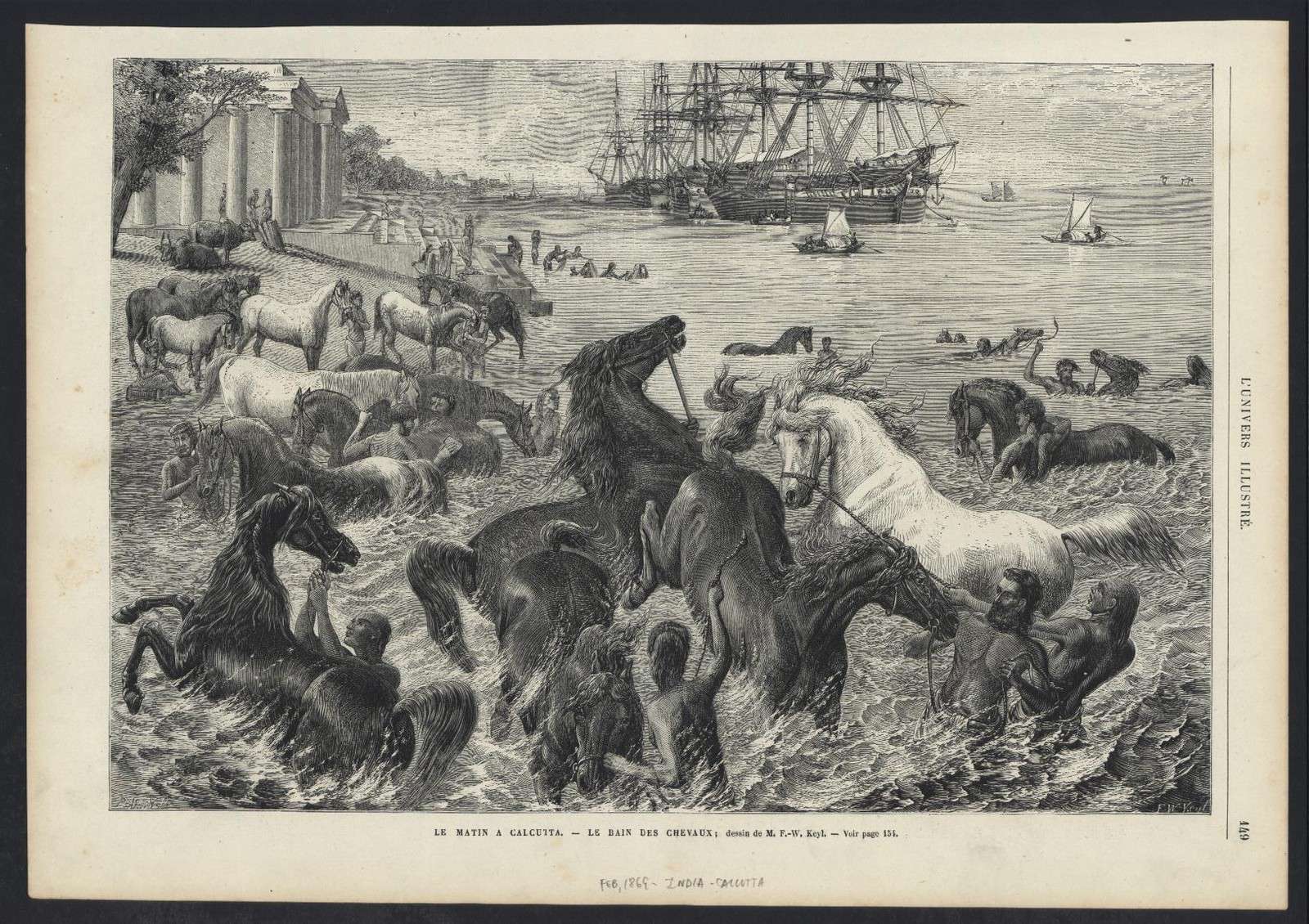
Update on "The Horses' Morning Bath in Calcutta"

Browsing through images of Calcutta in the Columbia University collection, I came across a far superior reproduction of said painting than the one I had previously shared. Here it is:


And it is from this that we also learn that the drawing is by Friedrich Wilhelm Keyl, a German painter, born in 1823 in Frankfurt. He moved to England and received training under Edwin Henry Landseer, a man known for his skilled representations of animals. Among Landseer's most well known works are the lions at Trafalgar Square. (Word has it that he could also paint with both hands at the same time.) Landseer drew a picture of his protégé (left). There's also a photograph of Keyl (right) that is available online.


It was Landseer who introduced his able pupil to the royalty, and Keyl quickly became something of - forgive the pun - the Royalty's Pet Painter. His drawings can also be seen in books like Curiosities and Wonders of Animal Life or Bible Animals. I cannot, however, say with any certainty whether or not he ever visited Calcutta. He died 1871. Apart from the painting itself, the rest of the post has very little to do with Calcutta, but there is something of personal interest that I wished to add.

The Chatterbox, a half-penny illustrated weekly for children, wanted a picture of Greyfriar's Bobby drawn from life. Greyfriar's Bobby is a story most South Point students (perhaps in other schools too) are familiar with. It was one of the few pieces in the Radiant Way that successfully made cold-hearted sadistic seven-year-olds reach for their neighbour's shirt sleeve (to wipe their eyes and nose). When Landseer turned down the Chatterbox commission, they asked Keyl. In June 1867 Keyl started work, but he later lamented that “…unfortunately the Engravers can not cut as I and others draw and you get only the Skeleton instead of the Spirit of one’s work.” [Jan Bondeson, Greyfriar's Bobby: The Most Faithful Dog in the World (Gloucestershire: Amberley Publishing, 2011)]  From the same book, here is Keyl's drawing of Greyfriar's Bobby.

Monday, August 4, 2014

Tiretta

I am currently trying to work on the extremely colourful life and times of Eduardo Tiretta. This post will be a fragmentary one. My intention is to bring to light a few things that I have recently found out about our man. It will by no means be a complete reflection of my research. I must thank Tintin da for first drawing my attention and interest to the figure of Tiretta and for the Casanova connection.

Tiretta was born in 1726. He was, as is commonly known, Calcutta's Civil Architect and Surveyor of Roads, and the man behind Calcutta's first 'purpose-built bazar'. One of the most colourful sides to his story is the fact that in 1762-63 he spent a fair amount of time with one Jacques Casanova. In his memoirs Casanova writes:
In the beginning of March, 1757, I received a letter from my friend Madame Manzoni, which she sent to me by a young man of good appearance, with a frank and high-born air, whom I recognized as a Venetian by his accent. He was young Count Tiretta de Trevisa, recommended to my care by Madame Manzoni, who said that he would tell me his story, which I might be sure would be a true one. The kind woman sent to me by him a small box in which she told me I should find all my manuscripts, as she did not think she would ever see me again.
I will leave it to the reader to follow the duo down their debauched path and their many exciting exploits, but two things are too tempting to let slip. Here's an excerpt from a conversation between host and guest.
Next day Tiretta came in, and said he had only just returned.
"You have been sleeping out, have you, master profligate?"
"Yes, I was so charmed with the she-pope that I kept her company all the night."
"You were not afraid of being in the way?"
"On the contrary, I think she was thoroughly satisfied with my conversation."
"[S]atisfied with my conversation" my foot! The conversation is, I suppose, what earned Tiretta the nickname "Count Six-times" and led to the following conversation between the "charming niece" and Casanova himself.
[Casanova] "Possibly, but the fact is that I was humbled by a circumstance I dare not tell you."
["charming niece"] "I think you are laughing at me with your 'dare not tell you.'"
"God forbid, mademoiselle! I will confess, then, that I was humbled because Madame Lambertini made me see that my friend was taller than myself by two inches."
"Then she imposed on you, for you are taller than your friend."
"I am not speaking of that kind of tallness, but another; you know what I mean, and there my friend is really monstrous."
Some time later Casanova notes, "If he had behaved well he might have become a rich man, but he got involved in some conspiracy and had to fly, and afterwards experienced many vicissitudes of fortune. I heard from one of his relations that he was in Bengal in 1788, in good circumstances, but unable to realize his property and so return to his native country. I do not know what became of him eventually."

Apart from the raunchy details, let me offer three findings. Firstly, the only known existing visual portrayal in James Gillray's 1792 painting, The Bengal Levee, possibly after a sketch by James Moffat (courtesy: British Library):


That person with the crooked nose right there is supposed to be Eduardo Tiretta, "greeting Father Parthanio, a Greek priest." 1792, when this was painted, was also the year that Tiretta was introduced to the girl who would be his wife - Angelique de Carrion of Serampore, then only 14 years old.

Angelique died in June 1796 at childbirth. (For these details I am indebted to Peter Robb's Sex and Sensibility: Richard Blechynden's Calcutta Diaries, 1791-1822, New Delhi: Oxford University Press, 2011.) She was buried in the Portuguese Church cemetery, which was meant for Catholics. Tiretta ran into trouble with those in charge for reasons I will not go into here and decided to re-inter his wife's corpse. He purchased a plot of land and called it Tiretta's Burial Ground. It came also to be known as the French Burial Ground. I can't find on the internet any mention of where that was, so I went in search and found it in two places, named two different things. In the map attached to the Monumental Register of Graves it was called Tiretta's Burial Ground. In the 1854 "Plan of Calcutta" it is referred to as the French Burial Ground. This is where it was.


And thirdly, and lastly for today, the advertisement for "Tiretta's Lottery" whereby he gave up many of his holdings in the city, including parts of (if not the whole) market. It was bought by a man named Weston, but we don't remember him that well. Rather depressing this.


[Please cite appropriately if you wish to use any of this information.]

Tuesday, May 27, 2014

Sunrise in Calcutta

I came across the "Sunrise in Calcutta" picture posted in an orphan state on the Calcutta - Photographs and Memories page on Facebook. I tried to locate it and it appears that in 1893 The Werner Company, Chicago, published a volume titled Illustrated Home Book of The World's Great Nations, "Embellished with over one thousand engravings by the Most Eminent Artists" and edited by one Thomas Powell.

I wanted to share a couple of images of Calcutta from this book along with some of the writings on it. But first, let me quote a brief passage from the Preface:
The intention of the Publishers, in this volume, is to present to the readers a brief but comprehensive account of all nations, from the rudest to the highest state of civilisation; and illustrating every phase of life with Engravings exactly representing the scenes described. This work embodies in this way the results of all the great travels and explorations of recent years, in which the photograph and pencil have combined to aid in giving us correct and detailed information never before attainable.
The claim that we can now offer "correct and detailed information never before attainable" is made by every generation of technology, and yet we keep fooling ourselves. Coming to the bit on Calcutta, the Compilers say:
About two hundred and fifty years ago, the British gained a foothold in India, and now it is entirely under their rule, either as British possessions, tributaries, or protected States. Calcutta is the capital of British rule. Although Bombay and Madras have governors, yet they are under the control of the Governor General of India, the most important and lucrative position in the gift of the British Ministry. Calcutta is a magnificent city, and boasts in the possession of the largest market on the face of the globe.
By this time, of course, the New Market has been completed, but I have my doubts regarding the status claimed for it in this brief article. After a few etchings of Hindoo fakirs and suchlike - incidentally, India is clubbed in the Contents under "Hindoostan, Siam, Etc." - we find a painting of Horses bathing, and one of a Calcutta Sunrise.

Horses Bathing at Calcutta 
Our illustration represents horses bathing in the Ganges, at Calcutta, in charge of the native grooms. The animals appear to be enjoying hugely their dip in the sacred river, and the picture throughout has more life than is usual in Oriental subjects.
The next is of the sunrise. Let me first share the accompanying text.
Sunrise in Calcutta 
Calcutta at early dawn presents a strange spectacle, especially in the suburbs, such as our illustration shows, where the old narrow streets prevail, and the tall structures of brick and stone are mingled with hovels of mud and bamboo. The rich native merchant does not, like the Englishman, take a fine, airy, salubrious site for his dwelling. The surroundings are to him a matter of indifference. He escapes the din of the thoroughfare, however, for great men's houses in Eastern cities usually turn their backs upon the public thoroughfare, that home of the many. Where stores line the streets, the shopkeepers, generally fruiterers, confectioners, druggists, and cloth-dealers, close their shops at nightfall and go elsewhere, making the ground-floor perfectly dark. At night these streets are lighted by floating lights set in large pans of oil by the roadside and coloured, Chinese-like lamps. The smell is terrible, and is increased by the odor of the people, who might well assume the name given by our people to the lower classes in Central America, "Greasers", for they really grease themselves with this oil. 
The street is, to many persons, a home, who as night advances, stretch themselves on the pavement to get a scanty repose, or what is worse, sit up all night singing "La! la! la!" at the top of their voices. As morning comes the lamps and cries die out, the dull, smoky smell becomes more intense as the sun approaches the horizon, and when at last he lifts his head above it for the adoration of the Parsee, the street population of Calcutta rouse them from their lairs, a ragged, squalid crowd, such as only Easter cities possess. It is less ragged, perhaps, than it would be had its members more clothes; in the majority of cases, the garment is confined to the neighbourhood of the waist: where more is worn, it is generally in rags, and in fact, still less a covering for decency. 
As the traffic of the day will require their bed-chamber, this crowd gradually rises and disperses to its various paths of mendicity and villainy. 
Then the shopkeepers appear and open the booths or verandas, which constitute their shops, resembling our news-stands, and creeping in here, they stand ready to deal with their customers on the sidewalk. 
I love this allegation: "The street is, to many persons, a home, who as night advances, stretch themselves on the pavement to get a scanty repose, or what is worse, sit up all night singing "La! la! la!" at the top of their voices." How extremely offensive. Anyway, here's the etching, and to be honest the architecture looks quite alien to me. I wonder if the Most Eminent Artist based this on any real view of Calcutta or its Environs at all.


Sunday, May 25, 2014

Bazar on a Rainy Day

It rained today after what seems like ages. The heat, as it does in cycles, had reached an unbearable degree. I got a little wet on my way back. I just wanted to share a photograph of a Behala street market, shot and shared by my friend Siddhartha Dey, with whose permission I am posting it here. Do the people, does the street know how gorgeous it all looks?


Wednesday, May 7, 2014

Midnight Drive

A few months ago, when Sroyon was in town, the family went out for a dinner. The Cousin Sister (credited at the end of the video) drove us around town till we reached Balwant Singh's Dhaba, photographs whereof have been posted before. Here's a silent video shot from the front seat of a Maruti 800. I am not sure if this will be of interest to very many, but may be one day we'll look back and wonder at how the city has changed. I thought it might be interesting to not mention the specific route that we took. I hope I'll remember. And that readers will figure it out, if they so wish.