Sunday, May 12, 2019

The Old Dog Race Course in Behala

Approaching Taratala from the south, one might notice on the left-hand side of the road a curious white-on-blue sign-board, which reads "Old Dog Race Course Housing Estate." In Kushanava Choudhury's The Epic City, this is where Manoj grew up: "a compound with dozens of uniform low-rise apartment buildings that stretched for perhaps a quarter of a mile from the main road."

The name of P. Banerji of 24 Parganas Rural South is justifiably forgotten in Kolkata's urban history. But it was he who, as a member of the Legislative Council back in the mid-1930s, had attempted to legalize dog racing in the city.

Dog racing has a much longer history in Britain—dating back to the late 18th-century at least—but between the wars, they imported from their US counterparts, a game-changing (literally) piece of technology: the electric hare. The rest of England waited impatiently as Manchester became the first city in 1926 to witness the Greyhound Race 2.0. The hare and the electric traps grew popular across British cities. "By 1933," according to Higgins and Williams (2006), "there were over 220 [tracks], many running three days a week." By one estimate, this was thrice the total number of horse-racing tracks in London! The races in Manchester were hosted at the Belle Vue and White City stadiums. Their popularity in London is evidenced by the fact that Wembley, Stamford Bridge and West Ham Stadium introduced them soon after. Watch this film by Pathe, showing an electric hare:


It is possible that the aforementioned P. Banerji hailed from Behala, where the nominal vestige of the race course can be seen today. His non-official bill proposing to legalize dog-racing was heard by the Council but, no thanks to his rambling manner of arguing, it lost by 47 "Noes" to 8 "Ayes." Why did he think this a good idea?

According to the only speaker who appears to have supported Banerji's motion, the reason for proposing the legalization of dog-racing was, at the core, noble. Taxes had been increased by the government and this was affecting adversely poorer sections of the society. The proposed bill aimed to tax an upper-class pastime, comparable to horse-racing. Thus, Shanti Sekhareswar Ray argued that if the Government were to increase the tax on racing to 10% from the existing 2.5%, it could easily meet the budget deficit without increasing taxes generally. "This will be," he asserted, "an acid test for Government, and they will have to make their position clear whether they want money from those who can afford to pay or money from those poor people who perhaps would have to pay under compulsion."

In principle, this was acceptable to some members of the Council. But one S.M. Bose came up with with the following bizarre argument:

"I would support this Bill if in place of 'dog' he would agree to substitute the word 'donkey. Many of us, Sir, have seen a donkey race, but none of us has seen a dog race."

Banerji's case was presented rather haphazardly. He had started out with a general tirade against gambling, drawing the Council's attention to its rampant abuse in the city. For some inexplicable reason, he specifically implicated the Chinese community in Calcutta:

"I may just state for the information of the house," (completely uncalled for) "that in the Chinese quarters in Calcutta gambling is going on every day. To come to the incident to which I was referring on the 4th of this month, that is on the Chinese New Year's Day, the Commissioner of Police, Calcutta, allowed certain clubs, e.g., the Toong Tung Club..." Unsurprisingly, he was cut short.

More pertinently he cited an act that was passed in England in November 1934, legalizing dog races under section 3(b), whereby a license tax had been imposed on the races. The Hon'ble R.N. Reid, a member of the Executive Council, argued justifiably that the case of England and India were completely different, since in England dog-racing was prevalent. He felt no need to encourage something that had only just started by according it a legal status.

Shanti Sekhareswar Ray was quick to point out, that a dog race had recently been seen to take place in a "well-known institution in aid of perhaps some charity." This, ironically, turned out to be under the auspices of the Society for the Prevention of Cruelty to Animals. Ray claimed that he had seen "a big advertisement on one of the buses belonging to that institution."

The clinching argument against Banerji's bill came once again from Reid. He pointed out the contradiction in Banerji's articulated moral position and accused him of being "quite prepared to debauch the populace by dog racing in order to raise money." But Banerji was adamant. He alleged, in turn, that the "members of the Government are members of the Royal Calcutta Turf Club," and it was their personal interest in removing a potential rival to their income, which motivated them to shoot down his proposal.

It is unclear to me as of now when this was legalized, but we are told that it was "subjected to heavy taxation by the Bengal Amusement Tax (Amendment) Bill, 1939" (Biswadeb Chatterjee, 1997), but was later abolished entirely.

The next time I pass by the spot, I'll try and take a closer look.

Thursday, May 17, 2018

Scallan's Illustrations for The Adventures of Bairam Khan

I had written an article on Frank Clinger Scallan for Scroll. Scallan also did the illustrations for C.H. Donald's The Adventures of Bairam Khan, published by Rai Sahib M. Gulab Singh & Sons of Lahore in 1930. Here are low-res versions of these wonderful full-page engravings.


Wednesday, May 2, 2018

The Death of Much Machee, the High Priest of Ghee Hung Chinese Church

H.E.A. Cotton
Going through one of H.E.A. Cotton's copies of Calcutta Old and New I came across several newspaper clippings the author had retained probably for future use. Among them is this report of unknown provenance on a Chinese funeral, which was mentioned in the Empire.
Let us all be buried in the ways that we severally prefer. Who is for the ceremonial recently observed at a funeral ceremony in Calcutta? It was the occasion when the remains of Much Machee, the High Priest of Ghee Hung Chinese Church, were interred in the Chinese burial-ground of that city. ''The body,'' says the ''Empire,'' ''was placed in a long box, and at the feet of the corpse was placed a table loaded with roasted sucking pigs and lambs and a variety of Chinese sweets. Two Phoophoo bands''--all Anglo-Indians will recognise with a shudder what that means--''were in attendance, and the music included pieces like 'The Raja of Bhong' and 'Tramp, tramp, tramp, the boys are marching.'''
"The Raja of Bhong" appears to be some sort of musical drama written by Adrian Ross (1859-1933). Ross was a renowned writer of musical comedies, popular in his day. In 1902 he had written in The Tattler a comic critique of Kipling's attempts at writing verse:

Give us the blending of East and West, of new and of old;
But don't go writing verses in the style of a common scold.
For it makes the metre rocky and it makes the rhyming weak,
And you never were a master of poetical technique.

Of "The Raja of Bhong" I have only so far found these stanzae that were added later:

There's a writer of rhymes that appear in The Times,
Who is down upon football and cricket,
And he pours out his soul on the oaf at the goal,
Or the flannelette fool at the wicket!
There was violence feared when his poem appeared,
But the poet was hardly a dreamer;
When the oafs in the mud came to look for his blood,
He was off to the Cape on a steamer!
Peace ! peace ! leave him in peace!
Though he pitches it rather too strong;
We'll forget how he sails if he'll tell us some tales
Of the beautiful valley of Bhong!

"Tramp, Tramp, Tramp" was a Civil War time song, composed by George F. Root in 1864. Here is a rendition -- trying to imagine what the funeral must have sounded like!


Monday, April 30, 2018

Gauhar Jaan as Hamlet

1898 onwards, Munshi Mehdi Hasan had written a number Urdu of adaptations from Shakespeare's plays. His Khun-e-nahaq (1898), Vikram Singh Thakur notes, "was transformed into a musical. The play opens in the court of Claudius 'celebrating the nuptials of Claudius and Gertrude with dance and music.'" Music became an integral part of these performances.

Thakur mentions that trained singers such as Amir Jan, Moti Jan, Gauhar Jaan, and Munnibai became associated with the Parsi stage.

In 1905, we are told, the Corinthian Theatre in Calcutta was hosting a Parsi theatre version of Hamlet in 1905, alongside "the tableaux dance of Kamr-al-Zaman-Badoora" on "bioscope worked by electricity." (Rosie Thomas, Bombay before Bollyood)

Gauhar Jaan, born Angelina Yeoward, was of Armenian descent. Her celebrity as a vocal performer reached foreign shores in the form of recordings and postcards and matchbox labels, as Vikram Sampath notes.

I am not aware of any reference to Gauhar Jaan playing Hamlet, or even posing as Hamlet for postcards, but here we are at the Corinthian Theatre, looking at this unlikely but amazing combination.

The postcard is currently part of my personal collection.

Wednesday, March 21, 2018

Canasta in Bombay

An attorney and an architect walked into the Jockey Club. In fact, it appears one of them lived half his life there for a while. Philip E. Orbanes writes that the Uruguayan  attorney, Segundo Santos, had become addicted to Bridge some time in 1939. He decided to switch to something lighter and with his friend, Alberto Serrato went on to invent a game called "Canasta" -- "a combination of the best elements of Bridge, Rummy, and a Rummy variant called 'cooncan.'" Canasta is the Spanish word for "basket", and the origin of the name is attributed by Orbanes to an act of whimsy.

The Illustrated Weekly of India reported on 18 March 1951, that the game had hit Bombay, and it like in many other great cities before it, had swept through the city's card-playing community.

As a non-card-player, I have often wondered at these phases that the communities of players seem to go through. Is it possible that the game-fatigue is perhaps not realized until something fresh suddenly appears on the horizon behind the hands they hold? I like thinking of how games travel -- of the figure of this magician, who cannot suggest something too unfamiliar to the players for then they may be taken for an outsider. Yet they know how to defamiliarize the familiar, how to make the shapes and numbers dance to a subtly different tune.

"Jayee," who wrote the Sportfolio column(bad puns are as old as language), reported that the "card game which began in an Uruguayan roadside cafe a couple of years ago, and soon swept the United States like a forest fire" has a "large portion of card-playing Bombay...in its thrall." It seems s/he had taken the trouble of learning that game, declaring it as a reasonably easy process. Among the game's most famous devotees, Jayee lists Dwight Eisenhower and Clifton Webb.

Is the game still played widely in Mumbai? Canasta seems to have reached Houston, via a few India exponents of the game.

Monday, April 24, 2017

Bridges of Calcutta #2: Alipore or Zeerut Bridge

Detail from map produced by the Society
for the Diffusion of Useful Knowledge
In this post we look South West at a bridge that crosses Tolly's Nullah at Alipore. W.H. Carey describes it as connecting "Calcutta and Alipore", the latter evidently not being considered within the strict municipal limits.

The nullah or creek-bed was completed in 1777, and was meant to facilitate passage of ships from Hooghly to the delta region by making use of the Khidirpur creek. It was the work of Colonel William Tolly.

On 27 August 1795 the old Alipore bridge, "which had been in a ruinous condition gave way and fell into the nullah." Calcutta, it appears, is not new to the phenomenon of collapsing bridges. Thankfully it happened at night and there were no casualties.

It nearly took another forty years for a bridge to be put in place. Once again, Captain John Thomson was assigned the task, and at the expense of rupees 26,430, he built the shortest iron bridge in Calcutta at the time, with a single curve of 89 feet and a roadway that was 24 feet wide.

William Wood, Alipore Bridge (1833), British Library collection
Sir Charles D'Oyly, The Suspension Bridge at Alipore (1848), British Library collection
Frederick Fiebig, Alipore Bridge (1851), British Library collection

H.E. Busteed recalls two trees that stood opposite the bridge. They were called 'The Trees of Destruction', "notorious for duels fought under their shade." This is where the fateful duel between Warren Hastings and Philip Francis took place in 1780.

The suspension bridge built in 1833 appears to have served a short span of time, being reconstructed in 1854. It underwent some alteration around 1904, which "rendered it a bridge worthy of Calcutta", but it is unclear what these were. H.E.A. Cotton felt that the modifications were made with "complete disregard for the picturesque." A new bridge was put in place in 1929, which serves the city to this day. We'll come to that later.

Sunday, April 23, 2017

Bridges of Calcutta #1: Chitpur Bridge

The Maratha Ditch was dug by the citizens of Calcutta in the mid-1700s to guard against a possible Maratha attack. The canal at Chitpur was revitalized in 1824, when the municipal authorities decided to use the waterway for transport.
From the British Library collection. Photograph by Frederick Fiebig (1851-52)
Map produced by the Society for the Diffusion of Useful Knowledge
A bridge was built in 1843 by Captain John Thomson, Superintendent of Canals, and Agent for Iron Suspension Bridges. We learn from W.H. Carey's The Good Old Days of Honorable John Company (1882) that it was valued at Rs. 39,344. Spanning 99 feet, the roadway was 22 feet wide. It was popular referred to as the Baghbazar Bridge.

Carey further records that under the bridge was a lock for allowing boats to pass between the river Hooghly and the Circular Canal at all times of the tide. "This lock is 60 feet long and nearly 24 feet wide, with double gates; it was constructed by James Prinsep, Esq. in 1829-1833, at an expense of 61,000 sicca rupees."

A new bridge was built a little to the East of the original bridge in 1934. More on that later.

Wednesday, April 5, 2017

A Run to Sumeru

Shoshee Chunder Dutt (1824-1885) was one of the most anthologized of Indians writing in English "back in the day". Apart from writing some mimic-poetry that is not altogether lacking in points of interest, as John Watson would say, he wrote The Reminiscences of a Kerani's Life. His prose essays, and his accounts of the 1857 war, offer insights into the times. Among Shoshee Chunder's best known poems is "A Vision of Sumeru", which narrates in classical form tales of the Hindu deities.

Recently I came across one of his more frivolous pieces, "A Run to Sumeru", where the author is whisked away by a Flibbertigibbet to Sumeru, where the Gods are acting in a most ungodly manner.
The Flibbertigibbet, or Imp of Satan, appears to be the personification (or impification) of the evils of Western culture. Not only does he quote Shakespeare, at the end of the story we find the author lying in a drain--the classic image of the Young Bengal wastrel--and looking for the mischievous influence.
The gods are consuming pork vindaloo, goose dumpoded, and Irish whiskey, in this drunken vision, as Saraswati flirts with Mahadeva. Bottles of Cordial Old Tom of the finest quality change hands, and Parvati ogles Vishnu.

The (clearly drunken) conversation about Shakespeare goes thus:
"Trust my wisdom once for all, and believe with old Will that there are more things in heaven and earth than are dreamt of in your philosophy."
"Well, really, this passes all bounds. You, Flib, have you the audacity to quote Will?"
"Audacity be hanged. I dined with him three hours ago in the groves of Chaitra-ratha; and were not we boon companions, both of us?"
"Now take care, Flib, or I shall break your head in earnest. You have been snarling over a bone with some dog, I suppose, named after the immortal bard of Avon."
"I have been drinking nectar (amrita) with the whole club of them, man; with Shakespeare, Milton, Homer, Vyasa, and Valmiki. Just trust your precious self with me for sixty minutes, and see if I don't get you into better company."
While this is suitably scandalous and impressive in its inappropriateness for its time, what struck me most is the opening passage.

The exact date for "A Run to Sumeru" is not given, but it was published in a volume titled Bengaliana: A Dish of Rice and Curry, and Other Indigestible Ingredients, in 1878. Do the first few paragraphs ring a bell?
After a hard day's work I was taking my siesta at the foot of my favourite citron-tree, having liberated my mind to divert itself for a while by a sentimental ramble over the vanities of existence. A slight rustling of leaves betrayed an intruder, and turning myself in that direction I saw, peering through the leaves, the mischievous face and leering eyes of that little rogue, Fliberrtigibbet, who tried to hide himself the moment he was seen.
"Come out from the copse, you little devil. What are you doing there now?"
"A cowrie for your thoughts, nuncle!" said he, grinning. "You are moping over the vanities of life, and would like to have a run to Sumeru."
"To Sumeru, you stupid? What for there?"
"Why, to see how the gods dispose of themselves to be sure."
Just for easy reference and cheeky speculation:
বেজায় গরম। গাছতলায় দিব্যি ছায়ার মধ্যে চুপচাপ শুয়ে আছি, তবু ঘেমে অস্থির। ঘাসের উপর রুমালটা ছিল, ঘাম মুছবার জন্য যেই সেটা তুলতে গিয়েছি অমনি রুমালটা বলল “ম্যাও!” কি আপদ! রুমালটা ম্যাও করে কেন?
চেয়ে দেখি রুমাল তো আর রুমাল নেই, দিব্যি মোটা-সোটা লাল টক্‌টকে একটা বেড়াল গোঁফ ফুলিয়ে প্যাট্ প্যাট্ করে আমার দিকে তাকিয়ে আছে!
আমি বললাম, “কি মুশকিল! ছিল রুমাল, হয়ে গেল একটা বেড়াল।”
অমনি বেড়ালটা বলে উঠল, “মুশকিল অবার কি? ছিল একটা ডিম, হয়ে গেল দিব্যি একটা প্যাঁক্‌পেঁকে হাঁস। এ তো হামেশাই হচ্ছে।”
...
আমি কিছুই বুঝতে পারলাম না, কিন্তু পাছে বেড়ালটা আবার সেইরকম বিশ্রী করে হেসে ওঠে, তাই সঙ্গে সঙ্গে হুঁ-হুঁ করে গেলাম। তার পর বেড়ালটা খানিকক্ষণ আকাশের দিকে তাকিয়ে হঠাৎ বলে উঠল, “গরম লাগে তো তিব্বত গেলেই পার।”
আমি বললাম, “বলা ভারি সহজ, কিন্তু বললেই তো আর যাওয়া যায় না?”
বেড়াল বলল, “কেন, সে আর মুশকিল কি?”
আমি বললাম, “কি করে যেতে হয় তুমি জানো?”

Monday, February 20, 2017

কল্‌কাতার দুপুর [A Calcutta Afternoon]

কল্‌কাতার দুপুর
কাঁশারিদের কাঁশির আওয়াজ ঝন্‌ঝনিয়ে বাজে,
ঘরের ভিতর একটা চড়ুই চেঁচায় কড়ির খাঁজে,
চিলের সরু কাঁপানো ডাক আকাশ হতে আশে,
একটা কাকে আল্‌শে-পাশে কেবল কলভাষে।
মাঝে মাঝে থাম্‌ছে ধ্বনি, নীরবতা জাগে,--
শব্দতীত কোন্‌ সে দেশের পরশ মোরে লাগে!
-শ্রীপ্যারীমোহন সেনগুপ্ত

Not the most inspired poem by this prolific writer perhaps, but these things tend to get lost.

Monday, December 19, 2016

All that is solid

In Jorasankor dhaare Abanindranath recorded one of the most evocative descriptions of the city of Calcutta. Towards the beginning in a short passage he describes the sounds he hears in the city from inside his house, may be even his room. We return to it either to remember some street cries that were familiar even some years back, or to read it as an archive of urban ephemera. Recently, while reading Khatanchir khata, published in 1921, I found another fantastic example of writing the city.

Those who are familiar with the story will know that it is a loose adaptation of Peter Pan. There is a young boy dressed in leaves and refusing to grow old. His name is Putu. Here are the kids describing and failing to describe who Putu is:
In Sona and Anguti-Panguti's maps of hidden lands, their mother began to notice the appearance of a half-bird half-human form, in adddition to Sonaton, Bohim, Ink-pot, the red notebook and the house-wife. They had written the word 'Putu' below. The pictures of Putu in Anguti-Panguti's notebooks were a little hazy but a much clearer picture could be seen in Sona's. Putu looked somewhat like a cross between rooster and human.
The children could never tell their mother who Putu was. She searched her memory hard but could find nothing of his kind in the stories they heard as children. What they did know for sure was that Putu would never grow up. He would remain exactly the size he was then. But then Putu starts leaving material traces in their house. They inform their mother that Putu plays the flute and enters the house through a window, dressed in leaves. One day she finds Putu's notebook. It contained everything--where he came from, why he remained ever young and how well he knew the city of Calcutta.

The city we find in Putu's books is one that functions exclusively in the realm of play. The cityscape changes continuously, but that does not prevent the author from presenting it in the form of a map. The map was drawn by one Sukumar Ray.
Maps that accompany literary works have interested me for a while now--you could extend that to spaces and literature more generally. I remember reading how R.L. Stevenson had first drawn a map of the Treasure Island story and only then written the book. But by the time he finished his novel he had lost the original map and had to reconstruct the place from his writing. I wonder what kind of exchanges Abanindranath and Sukumar Ray had while conceiving of this map of Calcutta.

Putu has known the city for many years and where we see offices and houses and tram-ways, he sees what used to be underneath the surface of what is.
In the day-time the buildings appear, but make no mistake, this does not mean the gardens are not there. You see that football field across the Gol-bagan? There is a giant pond with a banyan tree right below that. We used to go fishing in that pond. On some days I can still see the tree and the pond very clearly. How do you think that stork is surviving? Surely it doesn't feed on grass like a cow. At night when the pond comes back from its subterranean hideout, the stork hunts for fish there. That is how it has survived all these years.
As he plays with the vision of the city he must explain the changeability of forms. All that is solid in the city of Calcutta, which at that time was one of the most impressive models of western urbanity in the East, melts into air, giving way to visions of the past and the future. Abanindranath's manner of blending a keen interest in what exists--call it factual knowledge if you will--along with a sense of wonder is unparalleled (for me at least).
If you manage to stay up after two at night, you might take my word seriously. When the shiyals [foxes] of Sealdah start yelping in the dead of night, all the city's bricks turn into woods and gardens. As Putu starts playing her flute all the fairies come out with little lamps. You don't believe me? Wondering how stones and bricks can turn into plants, aren't you? Go to the museum some day. You will see trees that have turned to rocks and rocks that have become trees. You see the stars in the night sky, little specks of light? Once a star had fallen to the earth. They kept it in a glass box at the museum. It doesn't look like a radiant flower, but more like a lump of shiny iron.
 If you must explore the city, follow Putu, because he does not walk. Indeed the city is no more than the absolutely fantastical map and yet infinitely greater than the visible city.1
The road goes past Jorasanko and converges at the crossing. If you go south at the crossing, you cross Chowringhee and come to Raja-bagan. If you go north, you find Ray-bagan. Between these two great gardens lie two lakes, the size of the seas. In the Raja-bagan you find the rectangular Lal-dighi and at its heart the White Island. Inside the Ray-bagan is the Gol-dighi with the Jambu Island at its centre. The Great Raven with its many offsprings inhabits the Jambu Island, whereas the wingless fairies and faires live on White Island. Beyond the Lal-dighi is the king's fort, and on the banks of the Gol-dighi stand the living rooms of the babus. A picture of a cannon is drawn inside the fort, while a hookah denotes the living room of the babus.
Now let's take a look around Ray-bagan. It would take you fifty years to explore it on foot, but since this is a map we can cover it quicker.
 Not only do images and little symbols denote entire spaces in the city but also stand for the culture of a particular place (the hookah representing the living rooms of the babus), the letters in names of places become part of the map, including in themselves the very house where the reader of his book is.
What are you looking for? Our three-storeyed house? Look at the twin pools of Jorasanko. Notice the circle inside the loop of the 'R' of 'Pirbagan', which is written in the blank space between the pools. The house is right inside that. It's very small, but you can see it.
Sadly, you or I cannot look at the city quite in the same manner as Putu and must take his word about the real map of Calcutta. And why is that?
You see White Island and Jambu Island? No one who doesn't have wings can go there. To this day, I among all the children, have succeeded in visiting that place. You know why? It's because I never wanted to grow up.

1 Translations are mine. Quotations from Abanindranath Tagore, Khatanchir khata, in Abanindra Rachanabali Vol. 3, Kolkata: Prakash Bhavan, 1958.

Thursday, December 15, 2016

Coming Back to Life: The Electric Solution


You can't bring someone back from the dead but with the "Electric Solution" imported from America you can give a new lease of life to those who are dead in life. Just write to D.D. Hazra in Garden Reach.

The advertisement for the Electric Solution appeared on 31st August 1930 in the sixth issue of the Chuchura Barttabaha, or the Chuchura Post (?). If you weren't dead but felt dead you could try the tonic. It can cure anything starting from gonorrhea, erectile disfunction, neurasthania, piles and constipation among men. But it worked also on younger people, the elderly and even on women, who could be suffering from leucorrhoea, amenorrhoea and hysteria. It is priced at Rs. 1.50.

The science behind it has been proven by the renowned Dr. Petal of America, who has shown that there are three essential powers that operate in the human form: strength, virility and electric energy. If either of the three is lacking you can revive yourself by giving yourself a dose of this electric solution, which will instantly restore you to full and energetic function.

The Chuchura Bartabaha was founded by one Dinananath Mukhopadhyay. This Dinanath may be the same as the one who wrote Zamindari Bigyan (1866), a notoriously detailed manual for the zamindars of Bengal (particularly of the Hugli district), who might be struggling to keep their underlings and accounts under their control. For interested zamindars, the book is available at archive.org.

This rare newspaper has been digitized by the Centre for Studies in Social Sciences and may be found at: http://crossasia-repository.ub.uni-heidelberg.de/1610/.

Monday, September 26, 2016

The Translations of Mr. Lewis Da Costa, Esq.

I was looking for one Mr. Da Costa, who is supposed to have helped W.B. O'Shaughnessy find out about the use of cannabis in Indian medical traditions. I chased a wild goose for the first half hour, but when I finally had it by its throat, it changed colour and species and became a red herring.

The first one, then. Eager as I always am to believe in the unlikeliest possibilities, I first thought that the Da Costa who had helped O'Shaughnessy in 1839 was a poet, who appears to have written ghazals. These were published in the Jam-i-Jahan Numa between April 1827 and March 1828. Jam-i-Jahan Numa is among the first Urdu newspapers to be printed in India, if not the first. In an article titled "Persian Newspapers in the Hon'ble John Company Days" (1927) by Nawabzada F.M. Abdul Ali (quoted in European Poets of Urdu and Persian), the author suggests that it was subsidized for the first five years by the Government, 'for the Royal Arms appear on the title page and the news bears official appearance.' He describes Da Costa as 'the only Anglo-Indian writer of Urdu and Persian poems'--a contemporary of Derozio and J.W. Ricketts. 'These poems were written in faultless Urdu.' He claims that Mr. Da Costa was connected with Doveton College, Calcutta, and that his descendants lived in Sooterkin's Lane, Calcutta, in modest circumstances. The same Da Costa may have been involved with Dr. E.W. Chambers in his great effort to form the Eurasian and Anglo-Indian Association in 1876.

Now for the other Mr. Da Costa.

I have been able to track few biographical details so far. We know that before 1824 he was the Registrar at Cawnpore (of what?), and that in 1844, when his wife gave birth to their son on 12 June, they were residing in Sealdah. He had by the time become Assistant Persian Translator to the Government of India.

Was his translation of the Deewan Pusund his first major work? It may well have been. It is a long treatise on agriculture in the subcontinent, which he initially intended to introduce with some of his own "observations in regard to the general state of Agriculture in this country". He decided against it, leaving it to abler hands.

The Calcutta branch of the Prayer-book and Homily Society needed a translation of their prayer book. The existing body of prayers had first been translated by one Henry Martyn. In 1817, it was augmented with additional verses by Daniel Corrie, who went on to serve as Archdeacon in Calcutta and as Bishop of Madras. A new wave of enthusiasm in the late 1820s saw the society elders desiring translations into "Eastern languages".

One G.F. Brown, esq. of the East India Company's Bengal Service, had "translated the greater part of the prayer-book into Hindoostani". The manuscript passed from him to Corrie, and inevitably, on to Mr. Lewis Da Costa, "a competent Hindoostani scholar." "Mr. Da Costa offered a complete translation of the whole prayer book, including the thirty-nine articles and rubrics, made by himself, omitting only the state prayers." Archdeacon Corrie took the lead in the publication, and after comparing two versions produced the complete edition of the prayer-book in Hindustani in 1828.

The previous year, D.C. Smyth's An Abridgement of the Penal Regulations as enacted by the Governor General in Council, for the Presidency of Fort William in Bengal, had been translated into Persian by Da Costa.

Alexander Fraser Tytler
(1747-1813)
Arguably the most acclaimed translation by this polyglot came around 1829. He was to translate into Hindustani the enormous Elements of General History in 3 volumes, by Alexander Fraser Tytler and finished by Edward Nares. The volumes that were translated under the patronage of the Bombay Native Education Society, were priced at 25 rupees a set. The very next year, the learned Mr. H.H. Wilson of the Fort William College Council requested the purchase of 30 copies of "Mr. Lewis Da Costa's translation into Hindustani of Tytler's Elements of General History".

Encouraged by the success (and no doubt numerous other projects which I have not traced yet) he wanted to translate Mukhzun ul Udwiya by one Mohammad Khosru Khan, but found no sponsor. Instead, in the Journal of the Asiatic Society of Bengal (Vol. 6) he published an excerpt in translation "On the Properties ascribed in Native medical works to the Acacia Arabica". He signs off "Lewis Da costa, Esq." This was a teaser. "I therefore think it the wiser course in the first instance to publish a specimen by which the pharmacopeist will be able to judge the aid he might derive were the whole work (collated with others placed before him in an English translation." This is shortly after the newly formed Calcutta Medical College had propsed the formation of a Pharmacopoeia.

Is this the one that W.B. O'Shaughnessy takes up? Quite likely.

Monday, September 12, 2016

"जीना यहाँ"

I manage to catch the last south-bound metro. It's 22.00 by the time I reach the Central metro platform. The north-bound train comes in at 22.03. Non-AC. With six minutes to go till my train comes, I sit down on the metal bench. One other person at the end, tapping the screen of his phone aimlessly, mutters "That means the next one will be AC." At 22.08 we hear the echo of the incoming train. I get up and look into the void. The man's prophecy has been fulfilled. I imagine he has a smug smile on his face right now. We get into the same coach and realize quickly that the AC is not running--as it often happens with these trains. I grimace at him. The doors slide back, and a few seconds later the wordless tune of जीना यहाँ, मरना यहाँ, इस के सिवा जाना कहाँ comes on the internal music system. Several passengers who were grumbling silently realize all at once that tragedy has turned into farce, and break into chuckles and gentle abuse.

Thursday, September 8, 2016

Calcutta: Living City

Found this OUP brochure anticipating Professor Sukanta Chaudhuri's Calcutta: Living City while browsing through a second-hand book (Purnendu Patri's Job Charnock je Kolkata-e eshechilen) today.


Friday, June 24, 2016

Barber sits idle because mannequins have perfect hair


Saw this just behind Arsalan after a lunch with Debak and Vinayak. Vinayak needed to get some things photocopied--who am I kidding, xeroxed--and this happened right in front of the shop. Taken on Debak's phone.

Wednesday, June 22, 2016

Gräfin Elsa Albrizzi

Quite unwittingly Calcutta Confusion had shared with the wide wide world a most curious postcard of Clive Street while talking about Livierato's cigarettes.

Part of what I was doing while curating the postcard exhibit was to research as far as possible each of the names that appear in the postcard, either as sender, receiver or passing reference.

I could not read what was written on the recto of this particular card (except that it was written some time in 1905), so I turned to the verso. I would be most grateful if someone were to help out with the deciphering, but I reckon you'd have to know Italian.

The verso reads:

‘Italy
via Brindisi
??
Grāfin Elsa Albrizzi
Venedig
Palazzo Albrizzi’

The stamp appears to be dated January 21, 1905.

Further research.

The Palazzo Albrizzi (I clearly didn't know what to look for when I was in Venice!) is situated in San Polo, Venice, not far from the Rialto. The trading family of Albrizzis, originally from Lombardy, rose to eminence in Venice in the 16th century when they aided the Venetian government in their naval battles against the Turks. The richly decorated “palace” was acquired some time in the latter half of the seventeenth century. The addressee, Elsa Albrizzi appears to be a descendant of that same noble family, ‘Gräfin’ being a German title of nobility roughly translatable as ‘Countess’.

Elsa Albrizzi was one of the pioneering women to take to motor-car driving and racing. The most prominent name from the period is that of Bertha Benz who founded an organisation to encourage female racing drivers, and some sources claim the two knew each other. Madame Labrousse and Miss Wemblyn are the other two names that can be traced from the turn of the century, but it is Camille du Gast who became the first to consistently race on French tracks. You can see a photograph of Elsa Albrizzi and the car on the Museo dell'Automobile "Bonfanti-VIMAR" website.

Elsa Albrizzi is regarded as the first woman to finish in the top ten of a motor race (See SpeedQueens), as she came “ninth in the 1899 Padua-Vicenza-Thiene-Bassano-Trevisio-Padua Trail, driving a Benz light car.”

I wonder what she made of this view of Clive Street and who it was that thought of sending it to her!

Monday, June 20, 2016

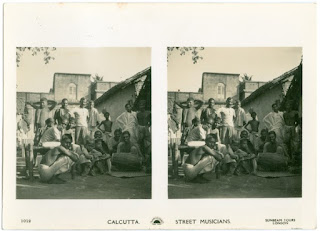
Stereoscope

বই ছাড়াও সময় কাটানোর জন্য ছিল একটা আশ্চর্য যন্ত্র। সেটার নাম স্টিরিওস্কোপ। তখন অনেকের বাড়িতে এ জিনিসটা দেখা যেত, আজকাল আর যায় না। ভিক্টোরীয় যুগের আবিষ্কার এই যন্ত্র। -- সত্যজিৎ রায়, যখন ছোট ছিলাম 
There was something else to help me pass the time. It was an amazing contraption called a stereoscope. Many families possessed one in those days but now this Victorian invention cannot be seen anywhere. -- Trans. Bijoya Ray, Childhood Days: A Memoir.

Old images of cities fascinate us. What sometimes escape our imagination are the many different ways in which things have been viewed over time; technologies, one could say. Panoramas were big in the early twentieth century. For us it is difficult to imagine the colourful place (if exclusionist) that the Maidan must have been at the time! Daniel White traces the travels of panoramic views of Dover (among others) from London to Calcutta in 1812. Within different cities opened up like pop-up books other cities. You would be required to climb up a few steps and from that vantage point you would see an enormous canvas all around you.

Over the course of the longish nineteenth century we also see the invention of photography. It seems to me, however, that the moment that is celebrated as the invention of photography is in fact the moment when people learn to capture mechanically the image that is produced by lenses upon a flat, 2D surface. These practices (including the camera obscura) had been in use for a long time

Towards the end of the nineteenth century we see the arrival of stereoscopy. Satyajit Ray recollects in his memoirs this amazing device. It underwent many changes over time and I have heard several people from our parents' generation recall its evolved cousin the View Finders and View Masters, which came with little circular disks.

Stereoscopy involves creating an illusion of depth on a 2D surface. The photographs that appear side by side on the card are almost identical, except for one crucial difference. They are taken with a camera with two lenses set horizontally apart. The two lenses capture the same moment from two subtly different perspectives--one for the left and one for the right eye. These are printed on cards exactly in that same way. This one is published by Sunbeam Tours, London. It's a picture of street musicians in Calcutta.

Once you look through the stereoscopic image viewer what you see are two distinct images with two eyes. If you allow your eyes to relax and try not to focus the two images fuse. It takes different amounts of time for different people, but the optics is so simple there's no reason for it to fail.

Recently at the 'Accessing the Archive' exhibition organized by the India Foundation for the Arts and Centre for Studies in Social Sciences (the three individual projects being funded by Voltas Ltd.), I had installed a viewer for public viewing. I hear this may have an afterlife, but we shall see about that. Apart from the ten cards I have in possession I had been fortunate to get hold of ten more from the British Library's archive, thanks to the good offices of Mr. John Falconer.

The British Library series (pub. Underwood & Underwood) photographed by James Ricalton, a US-based photographer, carries a fascinating story in itself. We shall come to that another day. For now, here's a gif version (a technique used particularly for the stereoscopic images of Japan) of the same card. I can promise you the actual viewer is much cooler! On the right is a photograph of the viewer that I designed and was executed beautifully by our family carpenter, Gautam Mandal. Below is the poster for the event.


Thursday, June 16, 2016

Jewish Family Postcards (2)

Calcutta Confusion is very tired, but also feels bad for neglecting Calcutta Confusion. While I'm working on a few things that can be vaguely termed as professional engagements, here are some more Jewish family postcards, courtesy of Ronnie Gupta--to whom I am more thankful than he knows.
The other series, celebrating New Year, is here.


Monday, March 7, 2016

‘There is a girl in Calcutta whose name is Margot’

In 1945 Captain Joseph Genovese described some of his experiences ‘as a pilot with the Ferry Service of the RAF’. How far his accounts are to be trusted is a different matter, but Genovese wasn’t the only one to write about Margot of Karaya Road. Margot’s name had spread far and wide in the British empire, then on the verge of collapse. John Costello says Margot was known as far out as Cairo.

‘She is fair, although not blonde, wears her hair brushed hastily back, shoulder length. Unexpectedly fresh-looking, with clear gray-green eyes…’

Much of the writing around Margot is unfortunately tasteless or fetishised. Genovese, who offers the most elaborate account I’ve read so far, can’t keep himself from orientalizing his experience. ‘Or perhaps it should be put this way: Margot lives in the Orient, in a city called Calcutta.’ He mentions her ‘barefooted and lovely young Indian maid’ who let him into the apartment—an apartment that ‘was like something out of the Arabian Nights, with little brown-skinned servant girls tiptoeing around the rooms, their bare feet sinking deep in the furry pile of the Oriental rugs.’ It’s 1945, Joseph! Seriously.

Allegedly a few years prior to his meeting with Margot, there was a murder in Bombay where a young British doctor was shot dead at home. Sensational news reports followed and it was reported that the young widow had known the murderer for a while. A love triangle murder was suspected, but the lady went scot-free. I have not been able trace this so far, and it is based on Genovese’s report.

57 Karaya Road was then in Calcutta’s suburbs—it is now on the stretch between A.J.C. Bose Road and Park Circus market. Genovese says that he and his friends had decided to pay Margot a visit. But it was her off night, and Genovese who had not entered the house—it was a brothel—was fortunate to meet Margot. They had heard of her at the 300 Club—a club that was founded in 1936 by ballet dancer Boris Lisanevich, who is also responsible for introducing Chicken à la Kiev to the Calcutta platter!

‘And then a voice, soft and husky and musical in the darkness, said, “Lonesome, soldier?”’

The two of them apparently spoke for an hour or two while his friends made merry inside with ‘Margot’s girls’. Genovese asked her out on a date the following night. His Galahadian impulse, as he puts it himself, is brimming over, as he imagines himself standing up for her against the ‘stuffed shirts in Calcutta’s high society.’ Margot’s interactions are expectedly smooth, as she stylishly rebuffs an overbearing Colonel at Firpo’s. A rather beautiful description follows:

http://www.printcollection.com/collections/classic-posters-advertising/products/calcutta#.Vt0xI4wrIy4
From PrintCollection.com
‘Originally the plan had been to go on to the Grand Hotel Bar after dinner, but when we stepped out into the bright lights of Chowringhee Road, the main thoroughfare of the city, and found a cool breeze blowing and the moon bright among the stars overhead, we decided to go for a walk. Across from us was the city’s principal public park, taken over in part by the Royal Air Force for use as a landing field and airbase, but still providing many acres of smooth lawn and shade trees for public use. We strolled there for half an hour or so, observing and talking the scores of people lounging on the benches or sprawling on the grass…Afterwards we wandered farther down Chowringhee, taking brief excursions into narrow little side streets lined with merchants’ carts and illuminated only by candlelight. At midnight we heard the bells of St. Anne’s Cathedral [sic] toll the hour, and little later we watched the crowd coming out of the Metro Theater.’


I like to think that they saw it that night—if at all—as Dilip Kumar DasGupta painted it. As always, Calcutta Confusion hopes to learn more about this lady.

This is part of my on-going research into the history of the Park Circus/Karaya Road area. Suggestions and references welcome.