Showing posts with label photography. Show all posts

Monday, June 20, 2016

Stereoscope

বই ছাড়াও সময় কাটানোর জন্য ছিল একটা আশ্চর্য যন্ত্র। সেটার নাম স্টিরিওস্কোপ। তখন অনেকের বাড়িতে এ জিনিসটা দেখা যেত, আজকাল আর যায় না। ভিক্টোরীয় যুগের আবিষ্কার এই যন্ত্র। -- সত্যজিৎ রায়, যখন ছোট ছিলাম 
There was something else to help me pass the time. It was an amazing contraption called a stereoscope. Many families possessed one in those days but now this Victorian invention cannot be seen anywhere. -- Trans. Bijoya Ray, Childhood Days: A Memoir.

Old images of cities fascinate us. What sometimes escape our imagination are the many different ways in which things have been viewed over time; technologies, one could say. Panoramas were big in the early twentieth century. For us it is difficult to imagine the colourful place (if exclusionist) that the Maidan must have been at the time! Daniel White traces the travels of panoramic views of Dover (among others) from London to Calcutta in 1812. Within different cities opened up like pop-up books other cities. You would be required to climb up a few steps and from that vantage point you would see an enormous canvas all around you.

Over the course of the longish nineteenth century we also see the invention of photography. It seems to me, however, that the moment that is celebrated as the invention of photography is in fact the moment when people learn to capture mechanically the image that is produced by lenses upon a flat, 2D surface. These practices (including the camera obscura) had been in use for a long time

Towards the end of the nineteenth century we see the arrival of stereoscopy. Satyajit Ray recollects in his memoirs this amazing device. It underwent many changes over time and I have heard several people from our parents' generation recall its evolved cousin the View Finders and View Masters, which came with little circular disks.

Stereoscopy involves creating an illusion of depth on a 2D surface. The photographs that appear side by side on the card are almost identical, except for one crucial difference. They are taken with a camera with two lenses set horizontally apart. The two lenses capture the same moment from two subtly different perspectives--one for the left and one for the right eye. These are printed on cards exactly in that same way. This one is published by Sunbeam Tours, London. It's a picture of street musicians in Calcutta.
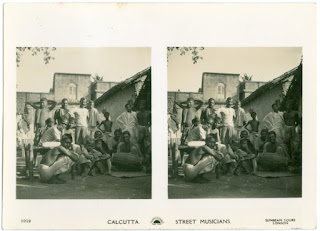
Once you look through the stereoscopic image viewer what you see are two distinct images with two eyes. If you allow your eyes to relax and try not to focus the two images fuse. It takes different amounts of time for different people, but the optics is so simple there's no reason for it to fail.

Recently at the 'Accessing the Archive' exhibition organized by the India Foundation for the Arts and Centre for Studies in Social Sciences (the three individual projects being funded by Voltas Ltd.), I had installed a viewer for public viewing. I hear this may have an afterlife, but we shall see about that. Apart from the ten cards I have in possession I had been fortunate to get hold of ten more from the British Library's archive, thanks to the good offices of Mr. John Falconer.

The British Library series (pub. Underwood & Underwood) photographed by James Ricalton, a US-based photographer, carries a fascinating story in itself. We shall come to that another day. For now, here's a gif version (a technique used particularly for the stereoscopic images of Japan) of the same card. I can promise you the actual viewer is much cooler! On the right is a photograph of the viewer that I designed and was executed beautifully by our family carpenter, Gautam Mandal. Below is the poster for the event.


Tuesday, December 30, 2014

Photography Divine

From time to time one comes across a text that seems so overwhelming in its implications that it's hard to talk about it. The questions of whether or not the divine, the truly sacred is mechanically, or digitally, reproducible have been long asked and answered. I'll quote a passage from Debganer Marte Agaman (The Gods Come to Earth) by Durgacharan Roy published in the 1880s that I found absolutely fascinating. The gods are visiting the Earth and after a tour of several places in India they have arrived in Calcutta. Having seeing the most obvious tourist sights...
They proceeded to another spot, where Narayan enquired, “Varun, what house is this?”
Varun: This is called a photographical establishment. For two rupees they will shoot your photograph.
Indra: Varun! Don’t you think it’s a good idea to take a photograph or two of the way in which we are touring Earth to show back in Heaven? What do you say, Grandpa?
Brahma: What’s the harm? Will they take a photograph of the group?
Varun: Why not?
“So be it”, Brahma laughed. “Narayan! Images of your tribhanga, flute in hand, are flooding the markets. Should we take one of you too?
Narayan: The all-seeing upon his swan is not far behind. If he’s getting one, why shouldn’t I?
They entered the house and decided upon the price. A sahib came and accompanied the gods to a dark room and made them sit. Upon entering the room Grandfather said, “Varun! This darkness is scaring me. Let’s get out of here. I don’t need a photograph.” Upa said, “Sir! Let’s see what the sahib is up to.” He stood up to look, then sat down and craned his neck. The sahib came running and said, “You are much too restless! Sit still. Otherwise the image will not come out right.” The sahib went out and before long the gods were looking at their own images and laughing. Upa kept looking from the image to Narayan, and back.
Narayan: What are you looking at?
Upa: They have drawn quite accurately. Why do the bazaar artists draw Grand Uncle in that monkeylike manner?
Brahma: How did you manage to draw so beautifully in such short time?
Varun: Sir—using a machine!
(Translation mine.)
 A few points about the translation (rather about the original): any single word or phrase denoting 'photograph' is used. The Bengali has "কয়েকখানি চেহারা তুলে নিলে হয় না?" A literal translation makes no sense at all, but the general idea is "capturing a likeness of the physical form". So as to not make it clumsy, I have used 'photograph' against better judgement. When Brahma asks if they take a group-photo, I decided to leave out the hyphen because the 'group-photo' as a discrete concept has probably not emerged.  Would have sounded anachronistic? But it's reassuring to see that the divinities also yield to the seduction of the 'having-been-thereness', so to speak.

Best not to add much to this.