Monday, June 20, 2016

Stereoscope

বই ছাড়াও সময় কাটানোর জন্য ছিল একটা আশ্চর্য যন্ত্র। সেটার নাম স্টিরিওস্কোপ। তখন অনেকের বাড়িতে এ জিনিসটা দেখা যেত, আজকাল আর যায় না। ভিক্টোরীয় যুগের আবিষ্কার এই যন্ত্র। -- সত্যজিৎ রায়, যখন ছোট ছিলাম 
There was something else to help me pass the time. It was an amazing contraption called a stereoscope. Many families possessed one in those days but now this Victorian invention cannot be seen anywhere. -- Trans. Bijoya Ray, Childhood Days: A Memoir.

Old images of cities fascinate us. What sometimes escape our imagination are the many different ways in which things have been viewed over time; technologies, one could say. Panoramas were big in the early twentieth century. For us it is difficult to imagine the colourful place (if exclusionist) that the Maidan must have been at the time! Daniel White traces the travels of panoramic views of Dover (among others) from London to Calcutta in 1812. Within different cities opened up like pop-up books other cities. You would be required to climb up a few steps and from that vantage point you would see an enormous canvas all around you.

Over the course of the longish nineteenth century we also see the invention of photography. It seems to me, however, that the moment that is celebrated as the invention of photography is in fact the moment when people learn to capture mechanically the image that is produced by lenses upon a flat, 2D surface. These practices (including the camera obscura) had been in use for a long time

Towards the end of the nineteenth century we see the arrival of stereoscopy. Satyajit Ray recollects in his memoirs this amazing device. It underwent many changes over time and I have heard several people from our parents' generation recall its evolved cousin the View Finders and View Masters, which came with little circular disks.

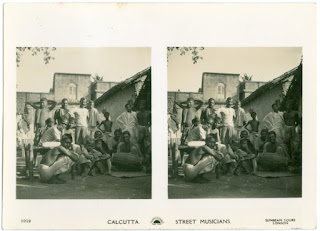
Stereoscopy involves creating an illusion of depth on a 2D surface. The photographs that appear side by side on the card are almost identical, except for one crucial difference. They are taken with a camera with two lenses set horizontally apart. The two lenses capture the same moment from two subtly different perspectives--one for the left and one for the right eye. These are printed on cards exactly in that same way. This one is published by Sunbeam Tours, London. It's a picture of street musicians in Calcutta.

Once you look through the stereoscopic image viewer what you see are two distinct images with two eyes. If you allow your eyes to relax and try not to focus the two images fuse. It takes different amounts of time for different people, but the optics is so simple there's no reason for it to fail.

Recently at the 'Accessing the Archive' exhibition organized by the India Foundation for the Arts and Centre for Studies in Social Sciences (the three individual projects being funded by Voltas Ltd.), I had installed a viewer for public viewing. I hear this may have an afterlife, but we shall see about that. Apart from the ten cards I have in possession I had been fortunate to get hold of ten more from the British Library's archive, thanks to the good offices of Mr. John Falconer.

The British Library series (pub. Underwood & Underwood) photographed by James Ricalton, a US-based photographer, carries a fascinating story in itself. We shall come to that another day. For now, here's a gif version (a technique used particularly for the stereoscopic images of Japan) of the same card. I can promise you the actual viewer is much cooler! On the right is a photograph of the viewer that I designed and was executed beautifully by our family carpenter, Gautam Mandal. Below is the poster for the event.


Thursday, June 16, 2016

Jewish Family Postcards (2)

Calcutta Confusion is very tired, but also feels bad for neglecting Calcutta Confusion. While I'm working on a few things that can be vaguely termed as professional engagements, here are some more Jewish family postcards, courtesy of Ronnie Gupta--to whom I am more thankful than he knows.
The other series, celebrating New Year, is here.


Monday, March 7, 2016

‘There is a girl in Calcutta whose name is Margot’

In 1945 Captain Joseph Genovese described some of his experiences ‘as a pilot with the Ferry Service of the RAF’. How far his accounts are to be trusted is a different matter, but Genovese wasn’t the only one to write about Margot of Karaya Road. Margot’s name had spread far and wide in the British empire, then on the verge of collapse. John Costello says Margot was known as far out as Cairo.

‘She is fair, although not blonde, wears her hair brushed hastily back, shoulder length. Unexpectedly fresh-looking, with clear gray-green eyes…’

Much of the writing around Margot is unfortunately tasteless or fetishised. Genovese, who offers the most elaborate account I’ve read so far, can’t keep himself from orientalizing his experience. ‘Or perhaps it should be put this way: Margot lives in the Orient, in a city called Calcutta.’ He mentions her ‘barefooted and lovely young Indian maid’ who let him into the apartment—an apartment that ‘was like something out of the Arabian Nights, with little brown-skinned servant girls tiptoeing around the rooms, their bare feet sinking deep in the furry pile of the Oriental rugs.’ It’s 1945, Joseph! Seriously.

Allegedly a few years prior to his meeting with Margot, there was a murder in Bombay where a young British doctor was shot dead at home. Sensational news reports followed and it was reported that the young widow had known the murderer for a while. A love triangle murder was suspected, but the lady went scot-free. I have not been able trace this so far, and it is based on Genovese’s report.

57 Karaya Road was then in Calcutta’s suburbs—it is now on the stretch between A.J.C. Bose Road and Park Circus market. Genovese says that he and his friends had decided to pay Margot a visit. But it was her off night, and Genovese who had not entered the house—it was a brothel—was fortunate to meet Margot. They had heard of her at the 300 Club—a club that was founded in 1936 by ballet dancer Boris Lisanevich, who is also responsible for introducing Chicken à la Kiev to the Calcutta platter!

‘And then a voice, soft and husky and musical in the darkness, said, “Lonesome, soldier?”’

The two of them apparently spoke for an hour or two while his friends made merry inside with ‘Margot’s girls’. Genovese asked her out on a date the following night. His Galahadian impulse, as he puts it himself, is brimming over, as he imagines himself standing up for her against the ‘stuffed shirts in Calcutta’s high society.’ Margot’s interactions are expectedly smooth, as she stylishly rebuffs an overbearing Colonel at Firpo’s. A rather beautiful description follows:

http://www.printcollection.com/collections/classic-posters-advertising/products/calcutta#.Vt0xI4wrIy4
From PrintCollection.com
‘Originally the plan had been to go on to the Grand Hotel Bar after dinner, but when we stepped out into the bright lights of Chowringhee Road, the main thoroughfare of the city, and found a cool breeze blowing and the moon bright among the stars overhead, we decided to go for a walk. Across from us was the city’s principal public park, taken over in part by the Royal Air Force for use as a landing field and airbase, but still providing many acres of smooth lawn and shade trees for public use. We strolled there for half an hour or so, observing and talking the scores of people lounging on the benches or sprawling on the grass…Afterwards we wandered farther down Chowringhee, taking brief excursions into narrow little side streets lined with merchants’ carts and illuminated only by candlelight. At midnight we heard the bells of St. Anne’s Cathedral [sic] toll the hour, and little later we watched the crowd coming out of the Metro Theater.’


I like to think that they saw it that night—if at all—as Dilip Kumar DasGupta painted it. As always, Calcutta Confusion hopes to learn more about this lady.

This is part of my on-going research into the history of the Park Circus/Karaya Road area. Suggestions and references welcome.

Tuesday, December 29, 2015

Jewish Family Postcards - New Year's Greetings

A couple of years back, Ronnie Gupta allowed me to photograph some of their old family postcards exchanged around New Year. His mother's side, were members of an old and well-respected Jewish family in Calcutta, the Hyams. These postcards (dating back to the sixties or seventies, I think), were exchanged between friends and family. Some were printed in Germany, but there's no publication detail visible on the three presented here. The background is usually a gorgeous multi-coloured reflecting surface.

My sincerest thanks to Ronnie for sharing these images.


Tuesday, November 10, 2015

Hallam Tennyson

I don't remember what I was looking for--probably something to do with Hallam's relationship with Alfred Lord Tennyson--when I came across this wonderfully named person, Hallam Tennyson. Turns out that he spent a few eventful years in Calcutta. I started reading his autobiography The Haunted Mind (London: André Deutsch, 1984) and decided that I must acquire a copy. At a modest price, a second-hand volume was located soon enough, and it has turned out to be one of my favourite autobiographies.

Who was Hallam Tennyson? He was the English poet laureate's great-grandson. Besides the autobiography he has written a novel, a collection of short stories, a couple of volumes on travel, and so on. We don't normally do book reviews in Calcutta Confusion, but for now I'd like to share my experience of reading the book.

When our author was born, he was announced in The Times as Beryl Augustine Evelyn. A great-uncle who was residing in the Isle of Wight intervened and reminded the family that his name ought to be commemorated. Thus, Evelyn was replaced by Hallam--I don't know how the rest of it came about.

HT talks about a deeply troubled relationship with his mother--and the memoirs on the whole, are more reflections and meditations upon life than they are a plain narrative of events. HT's mother, Ivy, also seems to have had a rather interesting affair with Bertrand Russell. Between his relationship troubles with Alys and the beginning of his affair with Lady Ottoline Morrell, it appeas Russell "took time off from the Principia Mathematica" to swoop in to "rescue" the young lady from a certain personal crisis. Remember, Russell also "rescued" Vivienne and Thomas S. Eliot.

Russell remembered Ivy well into her old-age. In characteristic manner he expressed this when HT once met him, as the latter recalls: '"Tell her I never go without thinking of her for more than a--" (and he [Russell] paused in order to consider the exact period of time: then added with great precision and finality) "--for more than a week." Ill as she was, my mother greeted this message with a roguish twinkle.'

Many years back, in the Tennyson family mansion in Farringdon, HT recalls getting into great trouble with his mother when she discovered an unfinished letter by him to a friend, where he was describing her as "horribly bourgeois and irritating."

Hallam Tennyson appears in his autobiography to be quite a remarkable man, given to introspection and contemplation. While at Eton he had several opportunities to explore his homosexuality--something he had never really tried to repress even as a child it seems. But he also experimented with heterosexuality, trying hard to feel attracted by the opposite sex. This he hoped to achieve by sleeping with pictures of Betty Grable and Ginger Rogers.

One of the most amusing characters to have entered into his life was a non-Etonion, who was "dark, clever, handsome and over six feet tall." This young man claimed that he HT had psychic powers and begged to be hypnotised. "Thereupon, in a pretended 'trance', he declared himself passionately in love with me: a declaration which he swore, on 'coming round', that he had completely forgotten." Later this man got himself thrown into prison for posing as a RAF officer and stealing lady's handbags. (Almost out of Wodehouse?) He became a stage actor, a film star, and a well-known writer, "each under a different pseudonym."

With another friend, Roddy Owen, HT started reading Freud in the newly published Penguin edition. "Our shrine, set up in his rooms," he writes, "consisted of a retable with a dove on top representing the 'super-ego' and a teddy bear in the middle representing the 'ego'. I have forgotten (significantly?) whatever it was we used at the bottom to represent the 'id'."

Following the outbreak of the Second World War, HT joined the University Ambulance Unit. The self-proclaimed Marxist, was also a vegetarian. He wore synthetic leather boots, protesting against the unnecessary slaughter of animals, but in characteristic self-deflating style, he mentions that "the soles parted company with the uppers at their first experience of rain, so that gesture came to a sticky end."

HT was to marry a lady by the name of Margot, with whom he spent many years. Margot was of a German-Jewish family, and she had lost every one of them in the War. They "became conscious of each other" some time in 1943 around the bonfire on Guy Fawkes night. Soon after he was sent to Egypt on service, from where he wrote a large number of letters in very small handwriting. The projects he had to manage are extraordinary. As his first assignment, he had to help Yugoslav refugees who had been evacuated off the Dalmatian coast. He describes a few scenes, such as the following:
In Sinai, following now established practice, I was put in charge of the camp kitchens. The Dalmatians who worked with me were a cheerful, even inspiring, band. They peeled spuds or stirred goulash to the accompaniment of endless folk and anti-fascist songs (the latter based on Slav folk tunes anyway). They all seemed to have this gift of song and modulated automatically into four-part harmony...Singing was indeed the refugees' only form of entertainment and expression(...) (78)
Towards the end of the war, HT was sent to Italy to survey the number of Jews missing and to take stock of the total destruction of property. Here he met Bernard Berenson and Leo Stein, brother of Gertrude Stein. Leo Stein had written a book on Art and Psychoanalysis which was largely a product of his memory and imagination since he had no access to a library. Leo was being disguised as his wife's servant in their home some where in the hills above Florence. The manuscript, which he had offered HT to read, got lost in transit. A version written later was published eventually.

The couple arrived in India in early 1946 after a three-week voyage. They landed in Bombay and quickly befriended Sachin Chaudhury, a Bengali gentleman, who comes across in the memoirs as a colourful character. Chaudhury was the General Manager of Bombay Talkies and carried with him a large supply of paan which "he had been too shy to chew in England" during a recent trip. With "his mouth stained a brilliant carmine", he offered HT and Margot "idiosyncratic" hospitality. He could quote at length from The Four Quartets. In a most remarkable passage the author offers a description of the whirlwind days in Bombay, which I personally identified very much with.
He refused to plan anything in advance and we seemed to pass the mornings wondering whether we were ever going to move out of the flat. Then at two o'clock in the afternoon we started weaving across the city by taxi, picking up friends for a lunch party which had only been decided on twenty minutes before A certain museum was chosen for an afternoon visit, but at three o'clock we had still not eaten, leaving two restaurants in disdain because they were unable to provide a sufficient variety of vegetarian food for one of our freshly gathered guests. We reached the museum at closing time but Sachin's charm kept it open for another two hours and afterwards the curator brought out his private collection from a locked safe. (98)
In Bengal, their work was mostly surrounding the famine-ridden areas surrounding Calcutta. HT was in Calcutta during the riots in July 1947 and witnessed great brutality in the streets. On one occasion he was mis-recognized as a Muslim person and Hindu Bengalis turned their attentions to him after he tried to save three defenceless Muslims from a gutter. I found his views on Calcutta quite honest--not patronizing in the least and far from romantic.

When he was offered the Star of India (Second Class) for their work in the Port Canning and Diamond Harbour area, he wrote back saying that any such effort should rather acknowledge the work of one Swarn Sarin. Swarn Sarin was a Punjabi woman, who had surveyed the area and bullied the Ministry into taking charge of the embankment attempts. "Swarn was the only person I ever met who could slowly masticate a large red chilli while continuing to talk about the problems of the jute industry."

In the middle of extensive surveys around Raghabpur, the couple also met Mahatma Gandhi at Ashram Sevagram. "The old man was jumping about on his mat and giggling in a frisky manner--his normal spirits in fact, as we were soon to learn." Continuing his deeply introspective vein, HT offers his analysis of Gandhi's sexuality (and later, of the question of feminism and women in Bengal)--written with nuance and incisiveness that I had not expected even half-way through the work.

After their return to England following a spell of bad health for Margot, Hallam Tennyson eventually served for several years as Assistant Head of the BBC's Radio Drama department and even went on to umpire at Wimbledon despite his general suspicion of sports. (I found quite to my horror that he was found dead in his apartment in 2005, in circumstances that are far from being pleasant.) The autobiography is well worth a read, and perhaps, some day I'll get down to reading the short stories as well.

Friday, October 30, 2015

Batman

This time it's Batman in Calcutta. Calcutta Confusion heartily thanks Eamon Lahiri for our second guest post.
The author is currently in his third year of pursuing a bachelor's degree in English at Jadavpur University. When he’s not watching sport, Eamon digs up cartoons, music, and random sights and sounds from his past to get nostalgic about. He claims to do precious little else.

I recently rewatched the Batman: The Animated Series episode titled 'The Demon's Quest', where Batman and Ra'as al Ghul make a very brief, and quite pointless stop at Calcutta on their way to rescue Robin and Talia al Ghul, who had supposedly been kidnapped.
Screen-grab from the Tv series
This two-part episode was based almost entirely on the Batman comics issue #232 published in 1970. Titled “Daughter of the Demon”, this was incidentally the issue that first introduced Ra’as al Ghul as a character.

While I quite enjoyed the story in itself, I found the portrayal of the city (in the comic as well as the television series) rather unsatisfactory. Everything from the art, to the colour schemes made it resemble a slightly toned down version of something out of an Arabian Nights tale.
Disgruntled with an inaccurate and hollow representation of my city, which I felt stemmed from misplaced notions that stereotype the vastly varied regions and cultures of the Eastern world, I set out in search for something more relatable. Thankfully, I didn’t have to look too far beyond Batman.

In 1996, DC published Batman #534, written by Doug Moench, who was on his second run under the Batman title, and was already known for contributing to the Knightfall arc in the 80’s.
This particular issue was a part of Legacy, a crossover story-arc that spread over issues from the Catwoman, Robin, and Detective Comics series’, apart from Batman. The overarching storyline concerns the return of the lethal virus that wreaked havoc in Gotham in the Contagion arc (to which this is a sequel), and Batman and his allies’ attempts to find its origins, and a possible cure, in the Middle East.


Unlike #232, #534 is set almost entirely in Calcutta, that too during the time of the year when the city is at its best: Durga Pujo.


But more importantly, unlike #232, #534 presents a much more realistic picture of the city.
For one, it moves beyond the ‘land of magic and snake-charmers’ stereotype and presents a view of the city from two distinct levels through the eyes of the caped crusader. At ground level, images of beggars lining the dingy lanes, urchins and street-dogs engrossed in play go a long way in juxtaposing the pomp of the festivities with the abject, perilous conditions in which the lower strata of society eke out a survival. Higher up, the unrealistic domes and minarets of #232 make way to tiled roofs and old Bengali bungalows that make for a much more familiar skyline.

Complete with Jim Aparo’s illustrations and Moench’s lines, nearly every panel strikes a poignant note with any reader who happens to be a resident of the city. A touching dialogue between Batman and a street-boy (who plays a crucial part in the story) hits too close to home for comfort when the latter is asked to go home when he encounters Batman late at night, to which he replies that the streets are his home. Anyone who has had a minimum amount of exposure to any part of the Batman franchise will be aware of Batman’s/Bruce Wayne’s deep concern and empathy for Gotham’s delinquent children, and as a true mark of a great work of fiction, the reader is able to get inside the head of a fictional character and almost sense the moment when he possibly realizes that the city he finds himself in, and the city he calls home are more similar than he’d like them to be.
Some of the lines, such as the ones in the panels below, are pertinent even today from a real-world perspective.

But where I feel this story scores a lot of brownie points, not just over #232 but in the broader context of Batman stories set overseas, is with the character of the aforementioned homeless child. While most of the stories in the arc are set in Africa and Asia, this is the only one that includes a local character who doesn’t just make up the numbers as a passive onlooker, but plays a major role in the plot.
Even though we never know his name, the boy turns out to be much more than a tertiary character. In fact, he is arguably the main supporting character despite Lady Shiva’s presence in the story. The writers ensure that his role is not restricted to being an object of sympathy and helplessness. His conversations with Batman evoke a sense of endearment towards him as well as humour (in contrast to the grim backdrop) as he continues flooding him with questions on his costume and whether he’s English or American, despite the Dark Knight’s best attempts to persuade him to stay away. Even after being shooed away, he continues to follow the duo from the shadows. Soon after, Batman does something quite out of character when he takes a ring off the finger of a hired assassin. As it turns out, he uses the ring to buy some food for the boy, a favour he later returns with interest when he (brace yourselves) comes out of the shadows and risks his own life to save Batman’s. This, I feel, epitomized the whole “Anybody could be Batman” motif that has gained so much of popularity after The Dark Knight Rises rocked the box-office in 2012, sixteen years before the release of Nolan’s film.

On a broader scale, the issue is also hugely successful in its streamlining of an out-of-the-box setting into the general mood and atmosphere of the DC animated universe within which Batman operates. Set as it is during a festive occasion, the squalor and decadence of the city is on full show. The stern reminder that evil isn’t far away even in the rare moments of joy is a staple of Batman stories set in Gotham, and the manner in which the same idea is evoked in a different setting is extremely refreshing.


Far from merely making up the background scenery, the city itself is portrayed as a multi-faceted character that actively engages with the plot and the other characters. We find the best example of this during the climax, which revolves around the immersion of the idols on Bijoya Doshomi,.
Batman discovers that the virus he has been seeking is hidden inside one of the immersed idols, put there with the aim to effect a contagion by contaminating the city's water supply.

With a great deal of help from his young friend, Batman manages to dive into the Hooghly amongst the idols, recover the virus, and save the day. Like all good Batman stories, a ray of light always breaks through at the end.

What I find particularly impressive is that despite the portrayal of the city being in line with the basic tropes of the fictional DCAU, one does not for one moment get the sense that it is forced. Through subtle hints, it encourages one to draw parallels between Calcutta and Gotham, while still enabling Calcutta to hold its own unique identity which is largely congruent with reality.

In an exchange with Lady Shiva, Batman articulates the enduring message that pervades throughout the story. It is the people of the city who make it what it is, and decide what it shall stand for. In spite of the chaos and corruption Calcutta (much like Gotham) finds itself surrounded in, the individual stories of the people who live in it are nothing short of inspirational. Their laughter, their spirit, and their very desire to survive despite the odds they face, nothing short of heroic.