Friday, June 24, 2016

Barber sits idle because mannequins have perfect hair


Saw this just behind Arsalan after a lunch with Debak and Vinayak. Vinayak needed to get some things photocopied--who am I kidding, xeroxed--and this happened right in front of the shop. Taken on Debak's phone.

Wednesday, June 22, 2016

Gräfin Elsa Albrizzi

Quite unwittingly Calcutta Confusion had shared with the wide wide world a most curious postcard of Clive Street while talking about Livierato's cigarettes.

Part of what I was doing while curating the postcard exhibit was to research as far as possible each of the names that appear in the postcard, either as sender, receiver or passing reference.

I could not read what was written on the recto of this particular card (except that it was written some time in 1905), so I turned to the verso. I would be most grateful if someone were to help out with the deciphering, but I reckon you'd have to know Italian.

The verso reads:

‘Italy
via Brindisi
??
Grāfin Elsa Albrizzi
Venedig
Palazzo Albrizzi’

The stamp appears to be dated January 21, 1905.

Further research.

The Palazzo Albrizzi (I clearly didn't know what to look for when I was in Venice!) is situated in San Polo, Venice, not far from the Rialto. The trading family of Albrizzis, originally from Lombardy, rose to eminence in Venice in the 16th century when they aided the Venetian government in their naval battles against the Turks. The richly decorated “palace” was acquired some time in the latter half of the seventeenth century. The addressee, Elsa Albrizzi appears to be a descendant of that same noble family, ‘Gräfin’ being a German title of nobility roughly translatable as ‘Countess’.

Elsa Albrizzi was one of the pioneering women to take to motor-car driving and racing. The most prominent name from the period is that of Bertha Benz who founded an organisation to encourage female racing drivers, and some sources claim the two knew each other. Madame Labrousse and Miss Wemblyn are the other two names that can be traced from the turn of the century, but it is Camille du Gast who became the first to consistently race on French tracks. You can see a photograph of Elsa Albrizzi and the car on the Museo dell'Automobile "Bonfanti-VIMAR" website.

Elsa Albrizzi is regarded as the first woman to finish in the top ten of a motor race (See SpeedQueens), as she came “ninth in the 1899 Padua-Vicenza-Thiene-Bassano-Trevisio-Padua Trail, driving a Benz light car.”

I wonder what she made of this view of Clive Street and who it was that thought of sending it to her!

Monday, June 20, 2016

Stereoscope

বই ছাড়াও সময় কাটানোর জন্য ছিল একটা আশ্চর্য যন্ত্র। সেটার নাম স্টিরিওস্কোপ। তখন অনেকের বাড়িতে এ জিনিসটা দেখা যেত, আজকাল আর যায় না। ভিক্টোরীয় যুগের আবিষ্কার এই যন্ত্র। -- সত্যজিৎ রায়, যখন ছোট ছিলাম 
There was something else to help me pass the time. It was an amazing contraption called a stereoscope. Many families possessed one in those days but now this Victorian invention cannot be seen anywhere. -- Trans. Bijoya Ray, Childhood Days: A Memoir.

Old images of cities fascinate us. What sometimes escape our imagination are the many different ways in which things have been viewed over time; technologies, one could say. Panoramas were big in the early twentieth century. For us it is difficult to imagine the colourful place (if exclusionist) that the Maidan must have been at the time! Daniel White traces the travels of panoramic views of Dover (among others) from London to Calcutta in 1812. Within different cities opened up like pop-up books other cities. You would be required to climb up a few steps and from that vantage point you would see an enormous canvas all around you.

Over the course of the longish nineteenth century we also see the invention of photography. It seems to me, however, that the moment that is celebrated as the invention of photography is in fact the moment when people learn to capture mechanically the image that is produced by lenses upon a flat, 2D surface. These practices (including the camera obscura) had been in use for a long time

Towards the end of the nineteenth century we see the arrival of stereoscopy. Satyajit Ray recollects in his memoirs this amazing device. It underwent many changes over time and I have heard several people from our parents' generation recall its evolved cousin the View Finders and View Masters, which came with little circular disks.

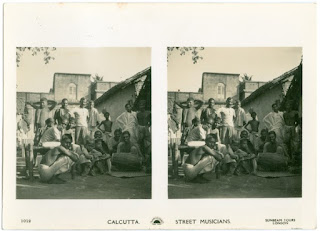
Stereoscopy involves creating an illusion of depth on a 2D surface. The photographs that appear side by side on the card are almost identical, except for one crucial difference. They are taken with a camera with two lenses set horizontally apart. The two lenses capture the same moment from two subtly different perspectives--one for the left and one for the right eye. These are printed on cards exactly in that same way. This one is published by Sunbeam Tours, London. It's a picture of street musicians in Calcutta.

Once you look through the stereoscopic image viewer what you see are two distinct images with two eyes. If you allow your eyes to relax and try not to focus the two images fuse. It takes different amounts of time for different people, but the optics is so simple there's no reason for it to fail.

Recently at the 'Accessing the Archive' exhibition organized by the India Foundation for the Arts and Centre for Studies in Social Sciences (the three individual projects being funded by Voltas Ltd.), I had installed a viewer for public viewing. I hear this may have an afterlife, but we shall see about that. Apart from the ten cards I have in possession I had been fortunate to get hold of ten more from the British Library's archive, thanks to the good offices of Mr. John Falconer.

The British Library series (pub. Underwood & Underwood) photographed by James Ricalton, a US-based photographer, carries a fascinating story in itself. We shall come to that another day. For now, here's a gif version (a technique used particularly for the stereoscopic images of Japan) of the same card. I can promise you the actual viewer is much cooler! On the right is a photograph of the viewer that I designed and was executed beautifully by our family carpenter, Gautam Mandal. Below is the poster for the event.


Thursday, June 16, 2016

Jewish Family Postcards (2)

Calcutta Confusion is very tired, but also feels bad for neglecting Calcutta Confusion. While I'm working on a few things that can be vaguely termed as professional engagements, here are some more Jewish family postcards, courtesy of Ronnie Gupta--to whom I am more thankful than he knows.
The other series, celebrating New Year, is here.


Monday, March 7, 2016

‘There is a girl in Calcutta whose name is Margot’

In 1945 Captain Joseph Genovese described some of his experiences ‘as a pilot with the Ferry Service of the RAF’. How far his accounts are to be trusted is a different matter, but Genovese wasn’t the only one to write about Margot of Karaya Road. Margot’s name had spread far and wide in the British empire, then on the verge of collapse. John Costello says Margot was known as far out as Cairo.

‘She is fair, although not blonde, wears her hair brushed hastily back, shoulder length. Unexpectedly fresh-looking, with clear gray-green eyes…’

Much of the writing around Margot is unfortunately tasteless or fetishised. Genovese, who offers the most elaborate account I’ve read so far, can’t keep himself from orientalizing his experience. ‘Or perhaps it should be put this way: Margot lives in the Orient, in a city called Calcutta.’ He mentions her ‘barefooted and lovely young Indian maid’ who let him into the apartment—an apartment that ‘was like something out of the Arabian Nights, with little brown-skinned servant girls tiptoeing around the rooms, their bare feet sinking deep in the furry pile of the Oriental rugs.’ It’s 1945, Joseph! Seriously.

Allegedly a few years prior to his meeting with Margot, there was a murder in Bombay where a young British doctor was shot dead at home. Sensational news reports followed and it was reported that the young widow had known the murderer for a while. A love triangle murder was suspected, but the lady went scot-free. I have not been able trace this so far, and it is based on Genovese’s report.

57 Karaya Road was then in Calcutta’s suburbs—it is now on the stretch between A.J.C. Bose Road and Park Circus market. Genovese says that he and his friends had decided to pay Margot a visit. But it was her off night, and Genovese who had not entered the house—it was a brothel—was fortunate to meet Margot. They had heard of her at the 300 Club—a club that was founded in 1936 by ballet dancer Boris Lisanevich, who is also responsible for introducing Chicken à la Kiev to the Calcutta platter!

‘And then a voice, soft and husky and musical in the darkness, said, “Lonesome, soldier?”’

The two of them apparently spoke for an hour or two while his friends made merry inside with ‘Margot’s girls’. Genovese asked her out on a date the following night. His Galahadian impulse, as he puts it himself, is brimming over, as he imagines himself standing up for her against the ‘stuffed shirts in Calcutta’s high society.’ Margot’s interactions are expectedly smooth, as she stylishly rebuffs an overbearing Colonel at Firpo’s. A rather beautiful description follows:

http://www.printcollection.com/collections/classic-posters-advertising/products/calcutta#.Vt0xI4wrIy4
From PrintCollection.com
‘Originally the plan had been to go on to the Grand Hotel Bar after dinner, but when we stepped out into the bright lights of Chowringhee Road, the main thoroughfare of the city, and found a cool breeze blowing and the moon bright among the stars overhead, we decided to go for a walk. Across from us was the city’s principal public park, taken over in part by the Royal Air Force for use as a landing field and airbase, but still providing many acres of smooth lawn and shade trees for public use. We strolled there for half an hour or so, observing and talking the scores of people lounging on the benches or sprawling on the grass…Afterwards we wandered farther down Chowringhee, taking brief excursions into narrow little side streets lined with merchants’ carts and illuminated only by candlelight. At midnight we heard the bells of St. Anne’s Cathedral [sic] toll the hour, and little later we watched the crowd coming out of the Metro Theater.’


I like to think that they saw it that night—if at all—as Dilip Kumar DasGupta painted it. As always, Calcutta Confusion hopes to learn more about this lady.

This is part of my on-going research into the history of the Park Circus/Karaya Road area. Suggestions and references welcome.

Tuesday, December 29, 2015

Jewish Family Postcards - New Year's Greetings

A couple of years back, Ronnie Gupta allowed me to photograph some of their old family postcards exchanged around New Year. His mother's side, were members of an old and well-respected Jewish family in Calcutta, the Hyams. These postcards (dating back to the sixties or seventies, I think), were exchanged between friends and family. Some were printed in Germany, but there's no publication detail visible on the three presented here. The background is usually a gorgeous multi-coloured reflecting surface.

My sincerest thanks to Ronnie for sharing these images.