Monday, September 26, 2016

The Translations of Mr. Lewis Da Costa, Esq.

I was looking for one Mr. Da Costa, who is supposed to have helped W.B. O'Shaughnessy find out about the use of cannabis in Indian medical traditions. I chased a wild goose for the first half hour, but when I finally had it by its throat, it changed colour and species and became a red herring.

The first one, then. Eager as I always am to believe in the unlikeliest possibilities, I first thought that the Da Costa who had helped O'Shaughnessy in 1839 was a poet, who appears to have written ghazals. These were published in the Jam-i-Jahan Numa between April 1827 and March 1828. Jam-i-Jahan Numa is among the first Urdu newspapers to be printed in India, if not the first. In an article titled "Persian Newspapers in the Hon'ble John Company Days" (1927) by Nawabzada F.M. Abdul Ali (quoted in European Poets of Urdu and Persian), the author suggests that it was subsidized for the first five years by the Government, 'for the Royal Arms appear on the title page and the news bears official appearance.' He describes Da Costa as 'the only Anglo-Indian writer of Urdu and Persian poems'--a contemporary of Derozio and J.W. Ricketts. 'These poems were written in faultless Urdu.' He claims that Mr. Da Costa was connected with Doveton College, Calcutta, and that his descendants lived in Sooterkin's Lane, Calcutta, in modest circumstances. The same Da Costa may have been involved with Dr. E.W. Chambers in his great effort to form the Eurasian and Anglo-Indian Association in 1876.

Now for the other Mr. Da Costa.

I have been able to track few biographical details so far. We know that before 1824 he was the Registrar at Cawnpore (of what?), and that in 1844, when his wife gave birth to their son on 12 June, they were residing in Sealdah. He had by the time become Assistant Persian Translator to the Government of India.

Was his translation of the Deewan Pusund his first major work? It may well have been. It is a long treatise on agriculture in the subcontinent, which he initially intended to introduce with some of his own "observations in regard to the general state of Agriculture in this country". He decided against it, leaving it to abler hands.

The Calcutta branch of the Prayer-book and Homily Society needed a translation of their prayer book. The existing body of prayers had first been translated by one Henry Martyn. In 1817, it was augmented with additional verses by Daniel Corrie, who went on to serve as Archdeacon in Calcutta and as Bishop of Madras. A new wave of enthusiasm in the late 1820s saw the society elders desiring translations into "Eastern languages".

One G.F. Brown, esq. of the East India Company's Bengal Service, had "translated the greater part of the prayer-book into Hindoostani". The manuscript passed from him to Corrie, and inevitably, on to Mr. Lewis Da Costa, "a competent Hindoostani scholar." "Mr. Da Costa offered a complete translation of the whole prayer book, including the thirty-nine articles and rubrics, made by himself, omitting only the state prayers." Archdeacon Corrie took the lead in the publication, and after comparing two versions produced the complete edition of the prayer-book in Hindustani in 1828.

The previous year, D.C. Smyth's An Abridgement of the Penal Regulations as enacted by the Governor General in Council, for the Presidency of Fort William in Bengal, had been translated into Persian by Da Costa.

Alexander Fraser Tytler
(1747-1813)
Arguably the most acclaimed translation by this polyglot came around 1829. He was to translate into Hindustani the enormous Elements of General History in 3 volumes, by Alexander Fraser Tytler and finished by Edward Nares. The volumes that were translated under the patronage of the Bombay Native Education Society, were priced at 25 rupees a set. The very next year, the learned Mr. H.H. Wilson of the Fort William College Council requested the purchase of 30 copies of "Mr. Lewis Da Costa's translation into Hindustani of Tytler's Elements of General History".

Encouraged by the success (and no doubt numerous other projects which I have not traced yet) he wanted to translate Mukhzun ul Udwiya by one Mohammad Khosru Khan, but found no sponsor. Instead, in the Journal of the Asiatic Society of Bengal (Vol. 6) he published an excerpt in translation "On the Properties ascribed in Native medical works to the Acacia Arabica". He signs off "Lewis Da costa, Esq." This was a teaser. "I therefore think it the wiser course in the first instance to publish a specimen by which the pharmacopeist will be able to judge the aid he might derive were the whole work (collated with others placed before him in an English translation." This is shortly after the newly formed Calcutta Medical College had propsed the formation of a Pharmacopoeia.

Is this the one that W.B. O'Shaughnessy takes up? Quite likely.

Monday, September 12, 2016

"जीना यहाँ"

I manage to catch the last south-bound metro. It's 22.00 by the time I reach the Central metro platform. The north-bound train comes in at 22.03. Non-AC. With six minutes to go till my train comes, I sit down on the metal bench. One other person at the end, tapping the screen of his phone aimlessly, mutters "That means the next one will be AC." At 22.08 we hear the echo of the incoming train. I get up and look into the void. The man's prophecy has been fulfilled. I imagine he has a smug smile on his face right now. We get into the same coach and realize quickly that the AC is not running--as it often happens with these trains. I grimace at him. The doors slide back, and a few seconds later the wordless tune of जीना यहाँ, मरना यहाँ, इस के सिवा जाना कहाँ comes on the internal music system. Several passengers who were grumbling silently realize all at once that tragedy has turned into farce, and break into chuckles and gentle abuse.

Thursday, September 8, 2016

Calcutta: Living City

Found this OUP brochure anticipating Professor Sukanta Chaudhuri's Calcutta: Living City while browsing through a second-hand book (Purnendu Patri's Job Charnock je Kolkata-e eshechilen) today.


Friday, June 24, 2016

Barber sits idle because mannequins have perfect hair


Saw this just behind Arsalan after a lunch with Debak and Vinayak. Vinayak needed to get some things photocopied--who am I kidding, xeroxed--and this happened right in front of the shop. Taken on Debak's phone.

Wednesday, June 22, 2016

Gräfin Elsa Albrizzi

Quite unwittingly Calcutta Confusion had shared with the wide wide world a most curious postcard of Clive Street while talking about Livierato's cigarettes.

Part of what I was doing while curating the postcard exhibit was to research as far as possible each of the names that appear in the postcard, either as sender, receiver or passing reference.

I could not read what was written on the recto of this particular card (except that it was written some time in 1905), so I turned to the verso. I would be most grateful if someone were to help out with the deciphering, but I reckon you'd have to know Italian.

The verso reads:

‘Italy
via Brindisi
??
Grāfin Elsa Albrizzi
Venedig
Palazzo Albrizzi’

The stamp appears to be dated January 21, 1905.

Further research.

The Palazzo Albrizzi (I clearly didn't know what to look for when I was in Venice!) is situated in San Polo, Venice, not far from the Rialto. The trading family of Albrizzis, originally from Lombardy, rose to eminence in Venice in the 16th century when they aided the Venetian government in their naval battles against the Turks. The richly decorated “palace” was acquired some time in the latter half of the seventeenth century. The addressee, Elsa Albrizzi appears to be a descendant of that same noble family, ‘Gräfin’ being a German title of nobility roughly translatable as ‘Countess’.

Elsa Albrizzi was one of the pioneering women to take to motor-car driving and racing. The most prominent name from the period is that of Bertha Benz who founded an organisation to encourage female racing drivers, and some sources claim the two knew each other. Madame Labrousse and Miss Wemblyn are the other two names that can be traced from the turn of the century, but it is Camille du Gast who became the first to consistently race on French tracks. You can see a photograph of Elsa Albrizzi and the car on the Museo dell'Automobile "Bonfanti-VIMAR" website.

Elsa Albrizzi is regarded as the first woman to finish in the top ten of a motor race (See SpeedQueens), as she came “ninth in the 1899 Padua-Vicenza-Thiene-Bassano-Trevisio-Padua Trail, driving a Benz light car.”

I wonder what she made of this view of Clive Street and who it was that thought of sending it to her!

Monday, June 20, 2016

Stereoscope

বই ছাড়াও সময় কাটানোর জন্য ছিল একটা আশ্চর্য যন্ত্র। সেটার নাম স্টিরিওস্কোপ। তখন অনেকের বাড়িতে এ জিনিসটা দেখা যেত, আজকাল আর যায় না। ভিক্টোরীয় যুগের আবিষ্কার এই যন্ত্র। -- সত্যজিৎ রায়, যখন ছোট ছিলাম 
There was something else to help me pass the time. It was an amazing contraption called a stereoscope. Many families possessed one in those days but now this Victorian invention cannot be seen anywhere. -- Trans. Bijoya Ray, Childhood Days: A Memoir.

Old images of cities fascinate us. What sometimes escape our imagination are the many different ways in which things have been viewed over time; technologies, one could say. Panoramas were big in the early twentieth century. For us it is difficult to imagine the colourful place (if exclusionist) that the Maidan must have been at the time! Daniel White traces the travels of panoramic views of Dover (among others) from London to Calcutta in 1812. Within different cities opened up like pop-up books other cities. You would be required to climb up a few steps and from that vantage point you would see an enormous canvas all around you.

Over the course of the longish nineteenth century we also see the invention of photography. It seems to me, however, that the moment that is celebrated as the invention of photography is in fact the moment when people learn to capture mechanically the image that is produced by lenses upon a flat, 2D surface. These practices (including the camera obscura) had been in use for a long time

Towards the end of the nineteenth century we see the arrival of stereoscopy. Satyajit Ray recollects in his memoirs this amazing device. It underwent many changes over time and I have heard several people from our parents' generation recall its evolved cousin the View Finders and View Masters, which came with little circular disks.

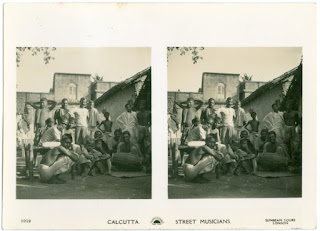
Stereoscopy involves creating an illusion of depth on a 2D surface. The photographs that appear side by side on the card are almost identical, except for one crucial difference. They are taken with a camera with two lenses set horizontally apart. The two lenses capture the same moment from two subtly different perspectives--one for the left and one for the right eye. These are printed on cards exactly in that same way. This one is published by Sunbeam Tours, London. It's a picture of street musicians in Calcutta.

Once you look through the stereoscopic image viewer what you see are two distinct images with two eyes. If you allow your eyes to relax and try not to focus the two images fuse. It takes different amounts of time for different people, but the optics is so simple there's no reason for it to fail.

Recently at the 'Accessing the Archive' exhibition organized by the India Foundation for the Arts and Centre for Studies in Social Sciences (the three individual projects being funded by Voltas Ltd.), I had installed a viewer for public viewing. I hear this may have an afterlife, but we shall see about that. Apart from the ten cards I have in possession I had been fortunate to get hold of ten more from the British Library's archive, thanks to the good offices of Mr. John Falconer.

The British Library series (pub. Underwood & Underwood) photographed by James Ricalton, a US-based photographer, carries a fascinating story in itself. We shall come to that another day. For now, here's a gif version (a technique used particularly for the stereoscopic images of Japan) of the same card. I can promise you the actual viewer is much cooler! On the right is a photograph of the viewer that I designed and was executed beautifully by our family carpenter, Gautam Mandal. Below is the poster for the event.