Showing posts with label old photographs. Show all posts

Saturday, December 21, 2013

Some More Lamp-posts, or Another Lamp-post Post (if you will)

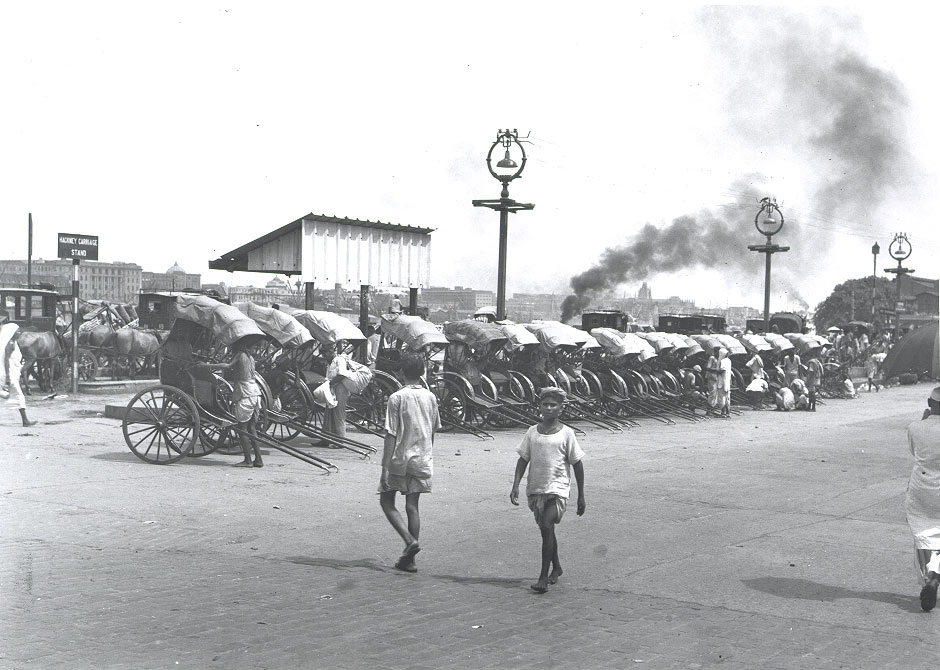
The Hensley Photo Library, University of Chicago, is a rich collection of photographs of Calcutta from 1943-44. They are a delight to browse through anyway. After the lamp-post in one of the photographs caught my eye, I kept looking for more varieties in each photograph.


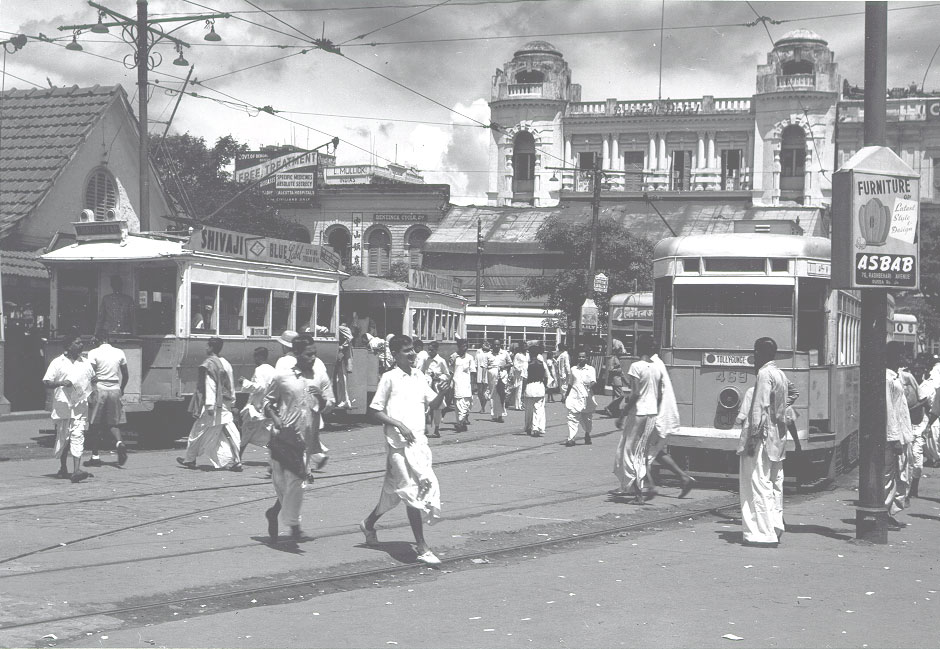
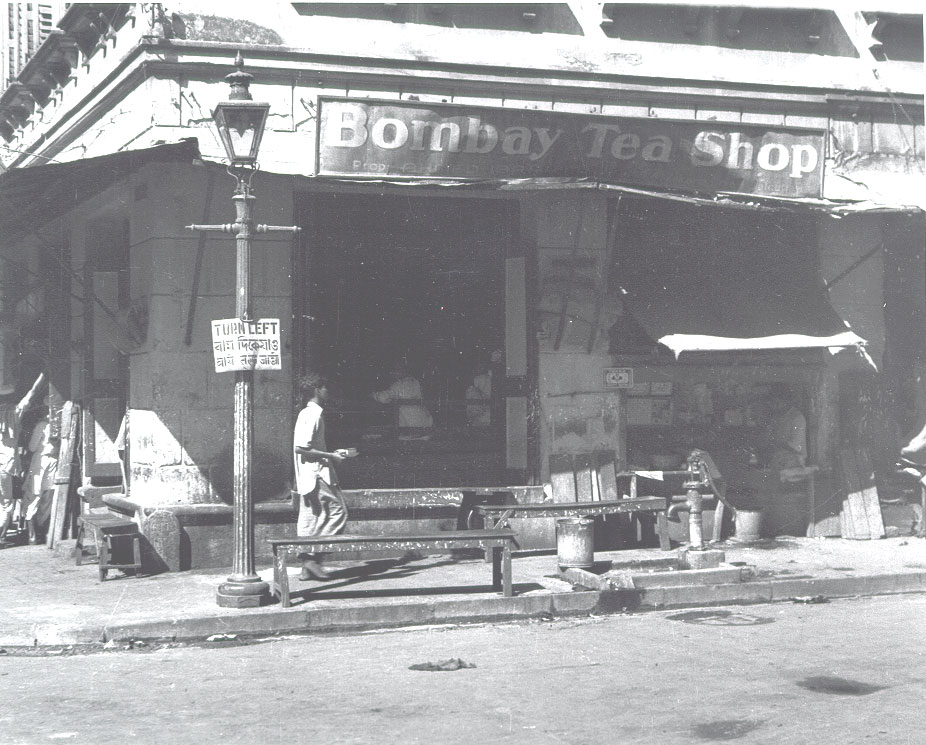
Yes, the sign-board says Bombay, but this is obviously from Calcutta. The archivist also says so.

"Public transportation awaits passengers in front of Howrah Station, Calcutta, 1944."

The first one is of the Howrah Station. The second is at Sealdah. Are the lamp-posts different because they are meant to light up different kinds of spaces? The first sheds light on rickhsaw or other public transport stands, while the latter is street-lighting. The Sealdah Station looks very different now. I do not know how and when the transition took place. It seems Hensley may have caught another photographer in the act: what else could the person squatting in the foreground be doing?

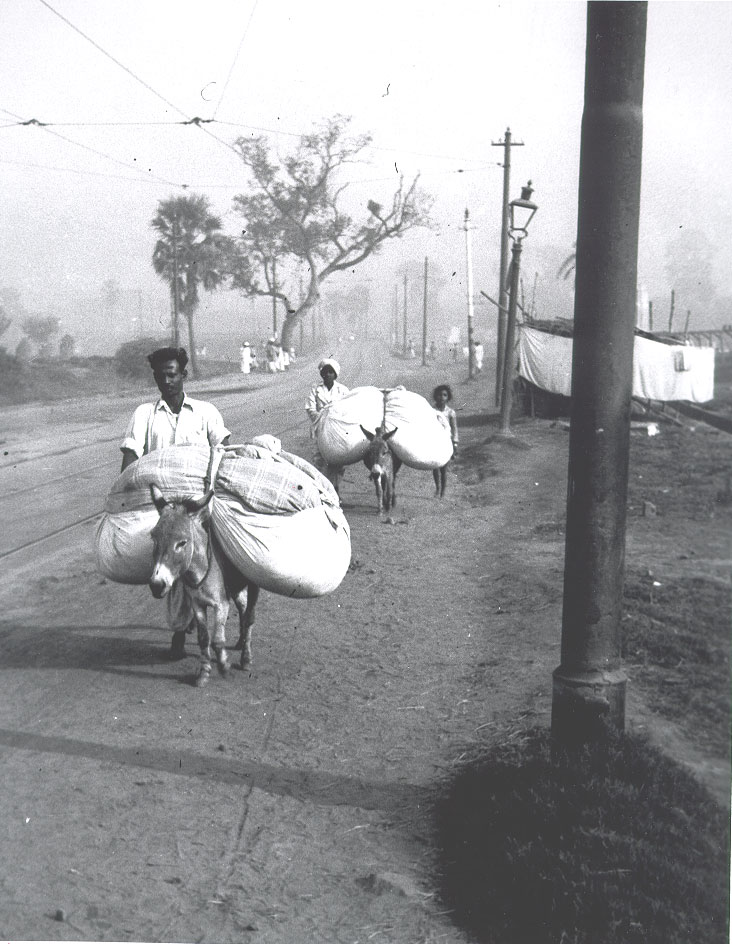
"Early morning scene along Diamond Harbor Road between Kidderpore and Alipore, Calcutta area"

This early morning scene echoes the lamp-post in the first photograph (in this post). You can almost smell the groggy freshness in the air. For the lamp too it seems too early to raise its head up absolutely straight. It's lazily tilted. Donkeys have become a rare sight in the city. A few days back I heard that the last donkey in Shantiniketan has died. Which broke my heart. Urbanisation and mechanisation are difficult conditions to survive in for a creature whose breeding, I suppose, came out of a largely utilitarian motive. Apart from carrying sundry load, they were also useful to dhoba-s or launderers (which may well be the subject of this photograph). They aren't very popular otherwise, are they? But they aren't even close to being endangered, and that is a relief.

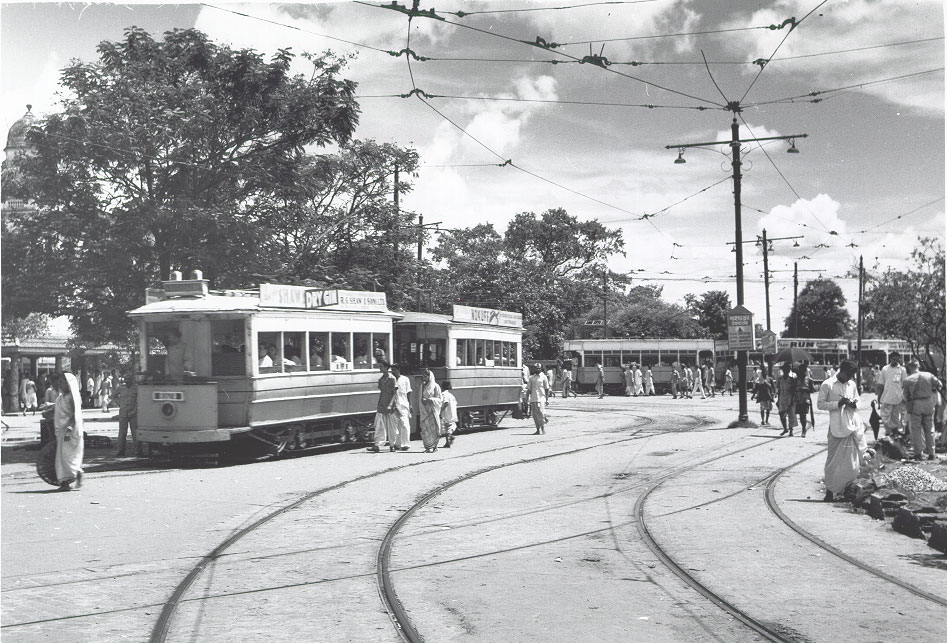
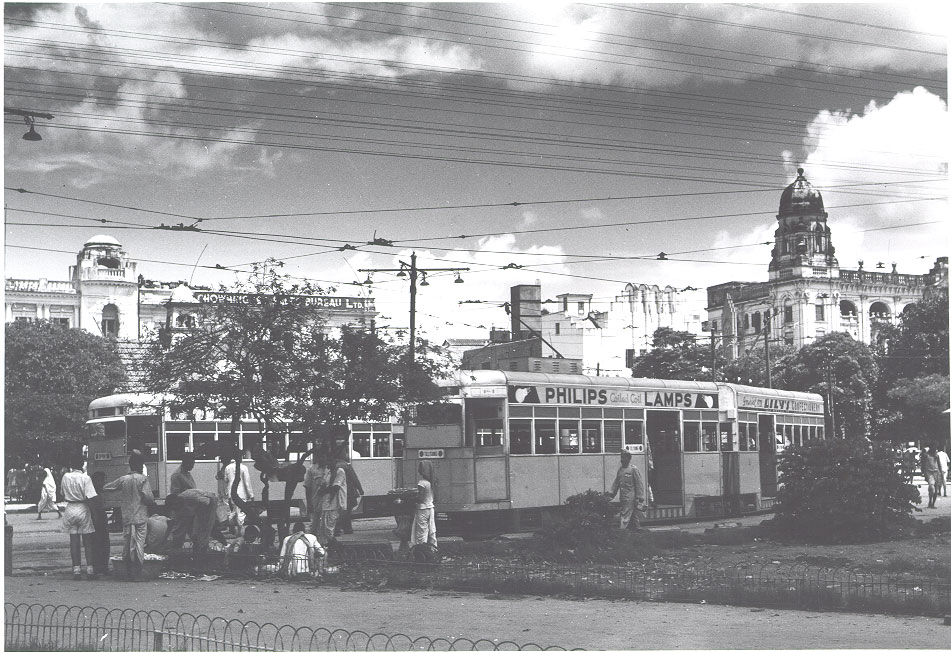
"Afternoon monsoon clouds form over the Maidan and Calcutta's downtown tram terminus, 1944."

The last three here are all from the Tram Terminus. The first one has two lamps to a pole, while the other two have four to a pole. The last photograph I found quite striking, what with the monsoon clouds in the background.

P. T. Nair tells us that while Harrison Road was the first to receive electric lighting around the turn of the century, it was not until 1914 that major sections of the city came to be illuminated thus. With an increase in the number of buses and trams plying the roads, the CESC started paying greater attention to street-lighting around 1927. Up until the 1950s, we are told, there were 4 classes of electric lights: i) 75 watt single lamps for very narrow passages; ii) 100 watt single lamps for lanes with little motor traffic; iii) 3-75 watt cluster lamps for roads with moderate traffic; and iv) 3-100 watt cluster lamps for major roads where the traffic was heavy. The height of the last type would range between 25 and 30 feet, and they would be separated from each other by about 150 ft.

Hope you have fun going through the rest of the photographs in the Collection.
Thursday, December 19, 2013

"Sans Souci"

You may be wondering why I have so little to say that is original. The happy reason is that, contrary to expectations with which I too had set out, there is a great deal that has been written about the city. If it isn't "primary research" I usually prefer to cite or even quote from my source. Paraphrasing, unless the text itself is confusing, seems a little lame, and I can't possibly assume an authoritative voice when I'm culling facts from elsewhere.

First of all, let me share the scanned image of the daguerreotype (somewhere Plato is turning in his...grave?) of the "Sans Souci" Theatre referred to in my earlier post. ["The "Sans Souci" Theatre of Calcutta. c. 1840. Photo: Siddhartha Ghosh. The earliest known example of a daguerreotype picture taken in Calcutta, which has survived only as a reproduction."]


When I was discussing the problem (of sharing or not) with my father, he suggested that I take a look at his copy of the St Xavier's College Centenary: 1960. The first article, "From Theatre to College" offered three interesting images and a bit of history. I find the language a little difficult to follow, especially since rhetorical flourishes often get the better of clarity. Some of the historical facts are clearly presented, while others not so. For the foundation story of the college, I think it worth going back to Radharaman Mitra (earlier referred to). He tells us:

A group of English Jesuits came to Calcutta on 8 October 1834 and established on 1 July 1835 the first St Xavier's College on Portuguese Church Street. In 1838 it was shifted to 3 Park Street, to a rented house. From there it moved again to 28 Chowringhee Road, to another rented house, in January 1841.
Trouble ensued between this group and Vicar Apostolic Carew. They closed down the college and left India in 1845. In September 1849 Carew purchased the building that currently houses St Xavier's College, which earlier used to be the "Sans Souci" Theatre, on premises numbers 10 and 11. Currently this is 30 Park Street. In the next month he transferred St John's College (of his own establishment) from its Entally premises to the Park Street address. He died in 1855 and the college shut down shortly afterwards.
A renewed appeal persuaded a group of Belgian Jesuits to come and work in India. On 28 November 1859, some of them arrived in Calcutta. They established St Xavier's College on 16 January 1860. Another version claims that St John's College did not in fact shut down in 1855. It lingered on and was rechristened and inaugurated as St Xavier's College on 16 January. (My translation.)
The essay in the Centenary volume quotes one Father Shea, who describes the old theatre:
...a showy building, with all sorts of what in theatrical language are called 'properties', and something like an acre of ground. The building is oblong; a good deal of it is devoted to a very fine portico and entrance hall. The audience part has the ordinary horse-shoe wall for the support of the boxes, etc., and this cannot be got rid of. You may easily imagine how much room is thus lost. The theatre was adapted to its present purpose in the following manner. A floor was raised about 12 or 13 feet from the ground, and the regions, commonly supposed to be the abode of ghosts and blue-fire, to which wicked barons and villains in general are consigned, are now a boy's purgatory - schoolrooms and so forth.
It provides an excellent photograph(?) of the premises, apparently taken in 1846. The "Sans Souci" building is still extant - you can identify it by the columns in the front. I wonder what the towering structure we are seeing in the background is. If I'm not getting the direct all wrong, we could be looking at St Paul's Cathedral. The Cathedral, it appears, was completed in 1847, but the spire could easily have been constructed a year earlier. This of course would be the old spire, modelled on the Norwich Cathedral, which broke as a result of the earthquake in 1934. (The new one was inspired by the "Bell Harry" Tower of Canterbury Cathedral.) I can't think of any other building of similar eminence in that direction with respect to St Xavier's College.


The article also says that the good Father H. Depelchin, "that shameless beggar", turned the fortunes of the school in the mid-1860s. The next bit is only by way of annotating the very interesting photograph that follows. "A British Company of buses had been started in Calcutta. It failed for want of travelling public. Fr. Depelchin acquired three of the conveyances for the paltry sum of Rs 400/-. They began going round, morning and evening, a moving advertisement to the spirit of enterprise of St Xavier's."


The other illustration in the volume that I found rather interesting is this "Sketch of the Old "Sans Souci" Theatre, about 1850." I admit that the angle is fairly obvious for viewing a building, but you will see that it matches line for line the daguerreotype from Sri Siddhartha Ghosh's collection. Could this be a hand-drawn reproduction of a mechanically produced daguerreotype image that had been taken four years earlier?